Halo Sobat ! | Members area : Register | Sign in
About me | SiteMap | Arsip | Terms of Use | Dcma Disclaimer

Footer

Powered by Blogger.

Social Icons

Featured Posts

Slider(Do not Edit Here!)

Minha lista de blogs

Publicidade 2

Cantinho do Blog

Parcerias

Hospedagens FREE

Dominios FREE

Publicidade 1

widget

Pojok Blog

Arsip

Sample text

Sample Text

Sample Text

Powered By Blogger
Powered By Blogger
Powered By Blogger

Perangkat SD

Perangkat SMP

Berita Pendidikan

Pengumuman

..::Aprendiz MUOnline::..

..::Ultimate Vendas::..

..::Central MU Online::..

..::Criando Portais::..

..::Viciados MU::..

..::Universe Divulgação::..

Visitor Counter

Google Search

..::Mixer Divulgação::..

You can replace this text by going to "Layout" and then "Page Elements" section. Edit " About "

..::Rádios Online::..

Recent Comments

..::Melhor Divulgação::..

..::Vermelho Divulgação::..

..::Extreme Divulgação::..

..::Control Downs::..

..::Divulgaçao::..

..::FreeXat parceiro top::..

..::Ciados MU Online::..

..::Nosso Banner no seu Site::..

About Me-

Seguidores

Seguidores

Social Icons

Musik

Translate

..::Majestic Hacker::..

..::Exclusivo MU Online::..

Translate to your language

Fox Life

Pages

Pages

Publicidade

Parceiros

Social Icons

Work Measurement in Textile Industry

Monday, 7 October 2013

Work Measurement:
Work measurement is the application of techniques designed to establish the time for an average worker to carry out a specified manufacturing task at a defined level of performance (to measure the time of a work for a worker). It is concerned with the length of time it takes to complete a work task assigned to a specific job .
Work Measurement in Textile Industry
Objectives of Work Measurement:
1. Work study: Work measurement is needed when we do work study. Work study or research can help to develop a current working procedure.
 
2. Comparison of alternative method: By doing comparison better method can be found.
  • Example: We have two methods and two are good, but after calculating the time we can see that one is taking less time than that of other. In that case we can select the less time select one (job).
3. Worker appointment: By counting or measuring the works of a worker we can select them.
 
4. Planning: By measuring the capacity of a machine we can plan how many machines are needed for a particular job.
 
5. Control: By measuring the works of a worker if we see production is not sufficient in that case we can tell the worker to increase his or her production that is it is helping in controlling of production.
 
6. Incentive: By measuring the works we can give incentive to the better worker as a result other workers will try more for getting the incentive bonus.
 
7. Budgeting: By measuring the works we can find how many men and machines are needed and how much do it cost and this cost is require for making the budget.
 
8. Costing: By measuring the works we can find out the labor cost.
 
9. Team work: How much team work is needed that we can find by measuring the volume of work.
 
10. Daily comparison: We can compare the time of everyday of works and the targeted time of a particular job then we can discuss with the worker for increasing the production speed.

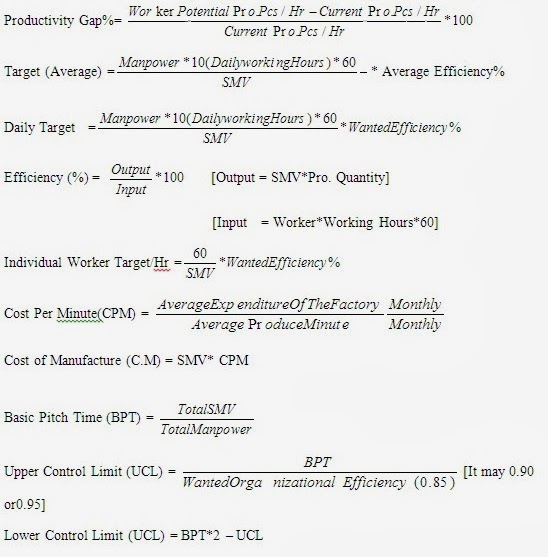
Work Measurement Related Formula:
Standard Minutes Value (SMV) = Observe Time*Rating +15% (Allowance)

Worker Potential Production Pcs/Hr = 60/BMV ( Basic Time = BMV= Basic Minute Value)

Worker Performance% = (SMV/1.15*100)/Tacct Time [Total average cycle check time]


Techniques of Work Measurement
The following are the principal techniques by which work measurement is carried out:
  1. Time study
  2. Activity sampling
  3. Predetermined motion time systems
  4. Synthesis from standard data
  5. Estimating
  6. Analytical estimating
  7. Comparative estimating
Of these techniques we shall concern ourselves primarily with time study, since it is the basic technique of work measurement. Some of the other techniques either derive from it or are variants of it.

The Uses of Work Measurement
Revealing existing causes of ineffective time through study, important though it is, is perhaps less important in the long term than the setting of sound time standards, since these will continue to apply as long as the work to which they refer continues to be done. They will also show up any ineffective time or additional work which may occur once they have been established.

In the process of setting standards it may be necessary to use work measurement:
  • To compare the efficiency of alternative methods. Other conditions being equal, the method which takes the least time will be the best method.
  • To balance the work of members of teams, in association with multiple activity charts, so that, as nearly as possible, each member has a task taking an equal time to perform.
  • To determine, in association with man and machine multiple activity charts, the number of machines an operative can run.
The time standards, once set, may then be used:
  • To provide information on which the planning and scheduling of production can be based, including the plant and labor requirements for carrying out the programme of work and the utilisation of available capacity.
  • To provide information on which estimates for tenders, selling prices and delivery promises can be based.
  • To set standards of machine utilization and labour performance which can be used for any of the above purposes and as a basis for incentive schemes.
  • To provide information for labour-cost control and to enable standard costs to be fixed and maintained.
It is thus clear that work measurement provides the basic information necessary for all the activities of organizing and controlling the work of an enterprise in which the time element plays a part. Its uses in connection with these activities will be more clearly seen when we have shown how the standard time is obtained.

History of Ready-made Garment (RMG) Sector in Bangladesh

Saturday, 5 October 2013

History of RMG Sector in Bangladesh

Muhaiminul Islam Ovi
Bangladesh University of Textiles
Email: ovi0907@gmail.com


Now a days textile sector of Bangladesh retains it’s top position in global market. This can’t be gained overnights. Bangladesh can get it’s present position by dint of merit and industry of people of Bangladesh. The base of textile sector was first established in 60th decade of the last century.”mercury shirts”which is originated from Karachi started the rmg business first.the industry exported shirts to the European market in 1965-66 first.
Workers in RMG Industry
In 1977-78 only 9 exporting industries were available in this country which deal with 10 million used every year.there were 3 big industries available in that time.they were:
  1. Riaz garments
  2. Jewel garments
  3. Paris garments.
Of them, Riaz garments was the most well known and oldest industry in that time.In urdu road of Dhaka it started it’s business with some tailoring shop first.In that time it was known as Riaz store.In 1973,it was named Riaz garments.In 1978,it started exporting products abroad.it exported 1 million pieces of shirts to the Olanda,a South Korean company.

Another garments known as Desh Garments ,also treated as the pathfinder of textile sector in Bangladesh.

In 1979 Desh Garments opened a joint venture project with south korean company “Daiyuu”.

At present RMG sector of Bangladesh deals with 22 billion USD every year.4 million people directly depend on the ups and downs of the sector.the 81% of the total export earnings are come from this textile sector.

The textile sector passes it’s golden time now.with the help of the government and different organizations we may hope for the betterment of this sector.

Garment Finishing Process

Friday, 4 October 2013

Finishing Process of Garments
Noor Ahmed Raaz
B.Sc. in Apparel Manufacturing
Asst. Merchandiser
Opex Sinha Group, Narayongonj
Email: raju.uttara72@yahoo.com


Garment Finishing:
Garment finishing through garment wet processing add value to the garments and the additional effects become the clear differentiator. Garment finishing can be used for various applications, be it shirts, trousers or t-shirts, but majority of the effects are most popular for causal wear and denim segment.
 Garment Finishing
PURPOSE OF GARMENT FINISH
  • Unless any product is characterized by value addition it is now impossible to survive in this highly competitive world market. Processing is important to make a usable but finishing gives value addition to it.
  • It makes garments attractive, comfortable & finishing can incorporate desirable properties.
  • Finishing is the heart of textile processing.
Value addition = {(Technology) + (Innovation)} x Quality.

The need for competitive strategy that utilizes;
  • Chemical compatibility to provide one-shot multifunctional finishes.
  • Cost reduction through process integration and minimizing the consumption of all utilities.
  • More environmentally friendly and application method.
  • Cost reduction through minimization of effluent treatment cost.
  • Improve process control, monitoring and automation.
  • Greater innovation in chemical finishes.
  • Quick response through right-first-time, right-on end time, right-every-time finishing.
  • Finishing of textile fabric is carried out to increase attractiveness and/or serviceability of the fabric.
  • Different finishing treatments are available to get various effects, which add value to the basic textile material.
  • The domestic readymade garment sector is booming, and garment processing has emerged as one of the important production routes towards meeting quick changing demands of the fashion market
METHOD OF APPLICATION:
There are two methods of garment finishing.
  1. Dip process.
  2. Tumbling process
Dip process: 
  • Dip the garment inside out in finishing chemical keeping MLR 1:5. Washing machine may be used.
  • Rotate the garment for 20 min.
  • Hydro extract the garment to 70 to 80% pick up.
  • Tumble dry at 70°C to moisture content 10—12 %.
  • Turn the garment right side out.
  • Iron/steam press the garment to set the creases at desired places.
  • Cure at 150—160°C
Tumble method:
  • In this process the garment are placed (inside out) into a machine with sealed (not perforated) cylinder and application of recipe by either pumping or spraying.
  • The drum is turned for 20 min there should not be excessive dripping of chemicals from the garment. If so more tumbling time is allowed.
  • This method is being used more and more due to the fact that there is no wastage of chemicals.
  • After saturation the garments are hydro extracted tumble dry at 70°C to 10—20 % pick up moisture content.
  • The iron and steam press the garments to remove/set creases. Cure at 150—160°C for 8 -10 min.
Important features:
  • MLR should not be less than 1: 0.85 for the garment weighing 600 gm and 1:1 for those weighing more than 600 gm.
  • Minimum time of tumbling should be 20 min.
  • Tumble rotation speed 20-30 rpm.
  • Tumble drying temp. Should not be more than 70°C.
  • Moisture retention after drying should be 10-12%.
Wash down effects
  • It can be achieved by a variety of garment processing techniques which are mainly dependent on physical and on chemical abrasion of the surface dye there by producing different wash down or break-in looks.
  • In garment washing the seams, waistband, pockets, cuffs, etc develop a contour, which can be obtained by washing in garment from only.
  • Washing down of garments is the latest development in fashion technology. Washing brings out special effects changing the feel and look of garments.
Five good reasons can be attributed for washing the garments.
  • To influence physical properties such as softness, handle, drape or fall , absorbency, creasing etc.
  • To influence appearance by altering the nature of yarn of fabric or lusture.
  • To create shrinkage & effects of shrinkage like puckering of garments.
  • To create abrasion & related effects.
  • To create a trend in fashion with consistent quality & brand image with range of finishes.
Garment Finishing Agents:
  1. Dispersing agents
  2. Lubricating agents
  3. pH regulator
  4. Anti back staining
  5. Anti cross staining
  6. Cationic dye fixing
  7. Stripping agent
  8. Optical brighteners
  9. Cationic & nonionic softeners
  10. Silicone softeners
  11. Additives
  12. Garment stage resin finish 
 

    Study Planning of Textile Engineering Students

    Thursday, 3 October 2013

    Study Planning of Textile Student
    Mohammad Shahadat Hossain
    Department of Textile Engineering
    Daffodil International University, Bangladesh
    Contact: +8801934386724 
    E-mail: shahadat1859@yahoo.com


    Introduction:
    Textile Engineering is a practical oriented applied science based subject which is including Mechanical & Chemical Technology. Our Universities or Engineering Colleges are offering Bachelor of Science course on this subject area. Most of the students of this subject are studying this subject on usual way but as we are living on the time of technological advancement as well as on globalization, we should come out from usual way to make difference & take challenge. I am trying here to give the guidelines consecutively to textile students for their uniform way of future building.
    Study Planning of Textile
    Primary Step:
    At first think about that why are you coming to textile education? How are you inspired? Conceptualize your logical thinking about this answer. If your answer is neutral like father’s wish or another’s suggestion but I have no wish, so forget about it. You should be positive about it & just think that, it is only your decision & don’t forget that, it is the way of your life & you must be responsible to make it better. One can give you suggestion but they can’t give you success, you have to make your successful future.

    As a Textile student, you should know what is textile & garments. Make a concept about local & global textile sector, what is the feature & historical background of textile sector of Bangladesh. By this time you are being ready to claim you as a textile student because you have been trying to grow your confidence about textiles.

    Next you have to concentrate on two necessary tools: English skill & Computer literacy which is must for the age of globalization but it doesn’t mean that you have to be the master. You have to have the knowledge of basic computing like MS office program & internet browsing. Programming, Photoshop, Illustrator, AutoCAD or graphics design can give you extra advantage. You should have to start practicing of English speaking. Don’t be shy about it; just try to make a circle/environment where you can practice English speaking. You shouldn’t think about grammatical mistake while you are talking rather you should avoid inertia to talk in English. You need not to go to depth of grammar, specially follow the rules of tense & know the technique of questions & answer. For the vocabulary, just try to memorize the word meaning what you know & note down it on your diary. You also try to find out the meaning what you don’t know, list down it on your diary & take the help of dictionary. Review this diary frequently & try to implement these words on your practical talking. You should start writing about any particular topic & always try to find out the way of business English writing (standard mail writing strategy to keep business communication).You can take help from your seniors, respective teachers or from web search.

    Secondary Step:
    You should learn what is the job prospect of Textile Engineer? What is the role, he plays? What are the positions of Textile Engineers in Textile & Garments industry? Ask it to your faculty, seniors or to your known textile individuals.

    Try to know about the number of textile industries in your country with breakdown like the number of weaving, dyeing, spinning & garments industries. You can know about conventional textiles like hand loom, the way of processing & their work culture centering the textiles. Also try to know that what is the export position of your country’s textile & garments product? What is the strength & what is the weakness of your textile sector? Start enjoying the media news & newspaper to get the latest news of textile sector. Try to enjoy the talk show related to textile business to know about expert’s thinking.

    Clarify your conceptual basic. Try to know about the renowned textile & garments industry of your country as well as renowned brand of word for what we manufacture RMG product. Try to know about the market of our RMG product like EU, USA or others. Visit renowned buyer’s website; know about their country of origin, product & policy. Also visit website of our textile industries & know about their product, resource, customer, compliance & so on.

    If possible try to visit Textile & Garment Industry personally or academically. Before visiting, please note down what you know from your theoretical basic & after visiting please note down what you have learnt from visit, try to match your theory with practical factory work. During visiting, you should treat as like as a reporter & please maintain a diary.

    Always try to attend on textile related seminar on your university or anywhere. Also try to attend on textile & garments exhibition with friend’s group to discuss for better understanding.

    Final Step:
    Always concentrate on your practical classes on your university lab. Don’t study only for your result rather you should concentrate on your enjoyable learning. Try to find out enjoy on your studies. Don’t be dependent on academic syllabus rather try to know something interesting from your study. Don’t learn by bindings of exam; try to learn by enjoyable mind. Keep in mind that your future is dependent on what you know & your power of innovation & exploration rather than your result.

    As a textile student, you must have to keep in mind that unity is strength. So start building communication with senior students, respect them & behave smartly & politely with your teacher & seniors. You should keep continuous communication with seniors & teachers. You can form group/ club on your University or your University may have Textile club. You should use textile club to rejoin with seniors, you can arrange session to take idea or knowledge from senior brothers/sisters who are working on different position of Textile & Garments Industry. Always try to share your knowledge & discuss the thing with your friends, senior brothers and teachers or textile individuals.

    Always think about practical. As your subject is textile & you are studying textile product manufacturing. So take a dress, analyze it & ask yourself that what is it? What is the parts name? What types of machines or processing is needed to manufacture it? How can I develop it? What are the components like fabric & accessories included? What is the fabric specification & appearance? Match your concept, note down all these things and try to remove confusion by discussing with teachers or senior brothers or friends or technical expert.

    Analyze the job market. There are so many department/section in textile & Garments industry; try to know about the role of textile engineers on these department, environment, work culture of these departments as well as the prospect of employee of every departments in future. Then set up your career goal, what will be your suitable one? Select your major or specialization area according to your career goal. Always try not to change your track, so after completion of graduation, try to join on the respective department according to your career goal.

    Internship period:
    Try to select an industry which is composite in nature (either it is small or bigger) because in composite industry, you can get all types of departments & respective machineries at one place.

    Always follow the instructions of academic & industrial supervisor. Be regular, work as like as a reporter, behave smartly & be presentable because you are carrying the image of your University as well as your personality, so be careful about it. You should be motivated on learning & try to mix up with the worker to know about their procedure, work culture & behave politely with them.

    Conclusion:
    I think that most of textile student can get idea from here & by incorporating with everyone’s own conception, they can be the asset for our textile sector as well as our country thus an industry can take a fresh textile graduate very warmly & Industries can expect textile graduate as best asset for their technological & business development.

    Parameters of the Process Control of Yarn Sizing

    Wednesday, 2 October 2013

    Process Control of Sizing

    Subrata Majumder
    Department of Textile Engineering
    Daffodil International University
    Email: eng.smder@yahoo.com
    Contact: +8801710541657 


    Sizing of Warp Yarn:
    The sizing of yarn absolutely essential to render it weavable; without sizing the end breakage rate of warp, particularly in the case of single yarns, is so high that weaving becomes impossible. The objective of sizing, however, sizing cannot be looked upon as a process that improves the basic quality of yarn. The fact is that by endowing the yarn with abrasion resistance, proper sizing bring out the full potential of a yarn to weave. A properly sized yarn should have adequate improvement in abrasion resistance, indirectly indicated by the increase in tensile strength, minimum loss of extensibility and required amount of moisture. For satisfactory weaving the quality of the beam also important; the beam should be firm and it should not have excessive missing ends, crossed ends, taped ends (sticky ends) etc., so that it unwind smoothly in the loom shed.
     
    We also want that in the sized yarn there should be:
    • Some increase in tensile strength in the yarn
    • Minimum loss of extensibility in yarn ( about 4.4-4.6% elongation at break is required for cotton)
    • Required moisture content ( 8-10% of cotton)
    • Good quality of sized beam (neither too soft nor too firm + free from yarn defects)
    • Good productivity and efficiency
    • Reduced Cost
    Some Important Parameters for the Process Control of Sizing:
    Process Control in Sizing:
    The process control program in sizing should, therefore, comprise of the following aspects:
    1. Selecting the correct size recipe and size pick -up level.
    2. Ensuring correct ratio of size paste.
    3. Control of the followings:
    • size pick up
    • stretch
    • moisture content
    • quality of beam
    • machine speed
    • machine efficiency
    • a method to calculate the expected level of productivity
    Effects of Sizing on Yarn Properties:
    The following properties of yarn are affected by sizing:
    • Yarn elasticity decreases.
    • Yarn strength increases.
    • Hairiness of yarn increases.
    • Flexibility of yarn decreases.
    • Smoothness of yarn increases.
    • Irregularity of yarn decreases.
    • Yarn diameter increases.
    • Yarn weight increases.
    Factor on which Sizing Recipe depends on:
    • Composition of yarn
    • Yarn count
    • Total no. of ends
    • Weight of yarn
    Factors Influencing Size Pick up%
    Viscosity of size paste in size box: Any variation in the concentration or temperature alters the viscosity of the paste which in turn affects both the level of size pick up and extent of penetration. Initially as the viscosity increases, the size pick-up also increases. But as the viscosity increases beyond a point, the size pick up is reduced.

    Squeezing pressure and condition of squeezing nip: The squeezing pressure determines the extent of penetration of the size paste between the fibers of the yarn and also of the removal of excess size paste and hence the level of the size pick up.

    Speed of the sizing machine: Other sizing conditions remaining unchanged, the size pick up increases with increasing sizing speed and vice versa. This is because the time available to squeeze the surplus size from the yarn is less at high speeds.

    Depth of immersion roller in size paste: the depth of immersion roller in the paste determines the duration for which the yarn remains immersed in the paste. This duration in turn influences both the level of size pick up and the extent of size penetration.
     
    Level of size paste in the size box: Variation in the level of size paste is an important source of size pick-up variations both within and between beams.

    Density of ends: When the density of ends is high, difficulties are encountered in obtaining adequate and uniform size penetration. Therefore size pick up may vary at these fabrics.

    Yarn tension: In case of higher tension during sizing the set of warp yarns encounter a stretch of comparatively higher tension and thus the set of yarn increases in length. If this increase is too high then the elongation property of the yarn will be decreased. So the yarn will face comparatively higher breakage in subsequent processes. On the other hand lower yarn tension leads to uneven sizing. So the yarn tension must be optimal.

    Yarn twist: In case of high twisted yarn penetration time should be increased in order to obtain the optimal pick up %.

    Dia. of the yarns: Yarn with greater dia consumes higher size paste. Therefore, the higher the dia of yarn, the higher the pickup will be added.

    Job Responsibilities of Merchandising Department in Apparel Industry

    Tuesday, 1 October 2013

    Garment Merchandising:
    Garment merchandising is an intricate and detail oriented job. If it can be done properly can be very rewarding. On the country, if it is done with lack of knowledge, insufficient skill and thoroughness, it can be destructive.

    The manufacturing factory as per the requirement suppliers the fabric and a ledger is maintained regularly to assess the production status. The accessories such as label, button, zipper, sewing thread, packing materials are collected from outside sometime mentioned by the buyer through back-to-back L/Cs.

    The merchandising department also looks for the sources for procuring yarns to produce fabric. Merchandising section monitors the production status regularly and ensures timely delivery of the shipment.

    Job Responsibilities of Merchandising Department:
    SECTION
    CORRESPONDING RESPONSIBILITIES
    DEVELOPMENT AND
    COSTING

    1. Reviewing the development packs RCVD from buyer.
    2. Put the developments into work with product development team.
    3. Clarify all necessary info with buyer as much as possible.
    4. Follow up on the delivered sample deadline.
    5. Work out the initial costing (all costing must be checked by merchandising manager)
    6. Price negotiation with buyer.
    7. Follow up with buyer regarding the feedback of the sample and costing
    ORDER
    CONFIRMATION

    1. Quoting the delivery dates to buyer after checking factory’s capacity situation.
    2. Checking all the details in the order sheet once received from buyer.
    3. Communicate with buyer regarding any discrepancy in the order sheet.
    4. Passing the correct order sheet to all concerned department i.e. planning, production, commercial etc.
    SAMPLING

    1. Updating production development team regarding different sample requirement of buyer at various stage (sales man, fit ,size set, pp sample etc)
    2. Coordinating all fabric + trims which are required for sampling purpose.
    3. Coordinating print, embroidery, wash for sampling.
    4. Checking all the technical aspects of samples before releasing to customer.
    5. Checking all the aesthetic aspects of samples before releasing to customer
    6. Checking the quantity requirement of each sample.
    7. Checking the necessary paper work of reach sample.
    8. Follow up the buyer regarding each sample comments.
    BULK FARBIC

    1. Work out the consumption for each new style from CAD.
    2. Provide fabric booking to fabric department with correct quantity and all necessary information.
    3. Follow up on the labdips/ strike off submission and chase
    4. Follow up on the fabric delivery against critical path
    5. Follow up on all fabric approval related issues.
    6. Prioritizing the fabric delivery schedule based on the garment delivery dates.
    BULK TRIM
    1. Preparing the cost sheet/ check list for individual trims
    2. Chasing the trim details from the buyer.
    3. Submitting required trims to buyer for approval.
    4. Provide booking for individual trims to the approved source.
    5. Chasing the P/I from the most ensure on time delivery.
    6. Monitoring the B/B L/C or TT payment status.
    7. Sourcing all trims from the most commercially viable source.
    8. Follow up with suppliers to ensure on time delivery.
    9. Lialise with store in order to ensure all trims RCVD in correct quantity and quality.
    EMBELLISHMENT

    1. Chasing the correct artwork for all print/embroidery from buyer.
    2. Developing the design in the best possible method
    3. Provide capacity booking to print /embroidery plant in advance.
    4. Submitting print/embroidery strike off for buyer’s approval
    5. Passing approved copy of the strike off to the print/embroidery plant.
    6. Negotiating the price with the subcontractors.
    7. Monitoring the panels sent and receive dates to ensure smooth production flow
    8. Communicate with supplier for general issues.
    FILING &
    CORRESPONDENSE

    1. Maintaining style file for all running orders
    2. Maintaining the development file.
    3. General correspondence with buyer and suppliers.
    4. Critical correspondence with buyer and suppliers
    5. Weekly updates for buyer, such as audit schedule, production status etc.
    MEETING

    1. Meeting with foreign buyers and suppliers.
    2. Meeting with local buyers and suppliers.
    3. Internal meeting with production, planning, quality, commercial and HRD.
     

    Melt Spinning Process | Feature of Melt Spinning | Advantages and Disadvantage of Melt Spinning

    Melt Spinning Process:
    Melt spinning is the most convenient and economic method for polymer fiber manufacturing at industrial scales. In melt spinning, the fiber-forming substance is melted for extrusion through the spinneret and then directly solidified by cooling. Melt spinning uses the heat to melt the polymer to a viscosity suitable for the extrusion through the spinneret. As the name indicates the chips of fibers are melted and extruded through the spinneret to obtain the fibers. It is used for the polymers that are not decomposed or degraded by temperatures necessary for extrusion. Polymer chips obtained from previously reacted chemical combinations are melted and then pumped through a spinneret in an air chamber. The extruded stream cool and solidify into continuous filaments and are then drawn out of the chamber twisted and/or processed further and subsequently wound onto spools. This method of spinning is suitable in manufacturing the polyester yarns.
    Melt Spinning Process
    Melt spun fibers can be extruded from the spinneret in different cross-sectional shapes (round, trilobal, pentagonal, octagonal, and others). Trilobal-shaped fibers reflect more light and give an attractive sparkle to textiles.

    Pentagonal-shaped and hollow fibers, when used in carpet, show less soil and dirt. Octagonal-shaped fibers offer glitter-free effects. Hollow fibers trap air, creating insulation and provide loft characteristics equal to, or better than, down.

    Requirements for Melt Spinning:
    • The polymer should not be volatile
    • The polymer should not decompose in the molten state and the melting point.
    • Polymer should be 30 degree centigrade less than its decomposition temp.
    Special Feature of Melt Spinning :
    • High production ( SPG. Speed 1000-2000 m/min)
    • Hazard , Non Toxic
    • No environment pollution.
    • No solvent required .
    • Heat of spg high.
    Fiber Characterizations:
    Different characterization methods were performed to study the resulting fiber properties, including microstructures, thermal properties, mechanical properties, rheological properties, molecular orientation and crystallization behavior.

    Fiber Which Processed by Melt Spinning:
    Polyester, Nylon, Olefin, Polypropylene, saran, and sulfar etc. are produced via melt spinning process.

    Advantages of Melt Spinning:
    1. Can be used for both staple and continuous filament.
    2. Direct and simple process.
    3. No environment pollution.
    4. High production speed (2500-3000) ft/min.
    5. Low investment cost.
    Disadvantage of Melt Spinning:
    1. Required more proper maintained of machine.
    2. Heat of input is high.