Halo Sobat ! | Members area : Register | Sign in
About me | SiteMap | Arsip | Terms of Use | Dcma Disclaimer

Footer

Powered by Blogger.

Social Icons

Featured Posts

Slider(Do not Edit Here!)

Minha lista de blogs

Publicidade 2

Cantinho do Blog

Parcerias

Hospedagens FREE

Dominios FREE

Publicidade 1

widget

Pojok Blog

Arsip

Sample text

Sample Text

Sample Text

Powered By Blogger
Powered By Blogger
Powered By Blogger

Perangkat SD

Perangkat SMP

Berita Pendidikan

Pengumuman

..::Aprendiz MUOnline::..

..::Ultimate Vendas::..

..::Central MU Online::..

..::Criando Portais::..

..::Viciados MU::..

..::Universe Divulgação::..

Visitor Counter

Google Search

..::Mixer Divulgação::..

You can replace this text by going to "Layout" and then "Page Elements" section. Edit " About "

..::Rádios Online::..

Recent Comments

..::Melhor Divulgação::..

..::Vermelho Divulgação::..

..::Extreme Divulgação::..

..::Control Downs::..

..::Divulgaçao::..

..::FreeXat parceiro top::..

..::Ciados MU Online::..

..::Nosso Banner no seu Site::..

About Me-

Seguidores

Seguidores

Social Icons

Musik

Translate

..::Majestic Hacker::..

..::Exclusivo MU Online::..

Translate to your language

Fox Life

Pages

Pages

Publicidade

Parceiros

Social Icons

History of Women's Costume: The Crinoline Period (1850-1869)

Tuesday, 22 October 2013

HISTORY OF WOMEN’S FASHION & DRESS: THE CRINOLINE PERIOD C.1850-1869
Jahanara Akter
Lecturer, KCC Womens College,
Khulna, Bangladesh


Fig: The cage Crinoline


Historical Background: The cage crinoline, the major fashion innovation for women in the1850s. During Romantic period, women used to wear Layers of petticoat, sometimes they are use up to six Layers of petticoat. The increasing width of women’s skirts had led to the use of more and more stiffened petticoat. When the hoop skirts of the 18th century were revived to hold out these voluminous skirts, the editor of peterson’s Magazine hailed its revival in September, 1859.This skirts look like a farthingale. But at this time women started wearing farthingale again. The farthingale had changed, its name was called “crinoline”. This was made out of still. A crinoline is a light still frame work covered with fabric to distend a skirt.

Women’s Costume:
Some woman’s costumes are described in below:

1. Undergarments:

Name of costume
Fabric
Pictures of dress
Description
a. Chemise
Cotton or linen
 
A short sleeve, knee length garments, short and full; without much decoration. 
b. Drawers
Cotton, linen or flannel
 
Knee length drawers were trimmed at edges with tucking, lace or embroidery. In winter some women wore colored, flannel drawers for warmth.
c. Camisole
Cotton or linen


This waist length a garment was shaped to figure had short sleeve and buttoned down the front.
d. Corset

 
Women were shaped with gores of fabric and inset gussets of elastic. After the introduction of the crinoline, corset shorted, when the crinoline declined, corsets become tighter.  
e. Hoop (cage crinoline)
cotton
 
Steel hoops were sewn onto tapes or fabric skirt. Shapes varied with changes in the fashionable silhouette: 1850s round, 1860s flatter in front and fuller at the back.
f. Petticoats
cotton, flannel
 
A single petticoat decorated with lace, embroidery, or small tucks was placed over the hoop. Additional layers, flannel petticoat worn in winter.

2. Day Time Dresses:
Some woman’s day time costumes are described in below:

a. Bodice:
Fabric: Silk, wool, cotton fabric are used.

Description: Bodice shaping was often achieved through curved seams in back, darts in front. Armholes were placed low on the arm. It is attached by button or hocks.
Fig: Women´s Bodice
b. Neckline:
Fabric: Silk, wool, cotton fabric are used.

Description: Neck lines were high, without attached collars and usually finished in bias piping. Removable, washable collars (and cuff) were usually worn with daytime dresses.
Neckline
c. Sleeves:
Fabric: Silk, wool, cotton fabric are used.

Description: Most common sleeve styles they were use such as: bell-shaped, pagoda shaped, double-ruffles, close sleeve, men’s coat sleeve etc.
Sleeves
d. Blouses :
Fabric: Silk, wool, cotton fabric are used.

Description: Separate blouses were worn with skirts. The Red Garibaldi Blouse was especially popular in the 1860s.
Blouses

e. Skirts:

Fabric: Silk, wool, cotton fabric are used.

Description: In1860s skirts were pyramid shaped.
Fig: Doam and Pyramid shaped Skirt in 1860s
3. Evening Dress:
a. Neckline:
Fabric: Different types of fabric are used.

Description: Different in dresses worn for evening. In the evening time they also wore daytime dresses. Most evening dresses had “off the shoulder” neckline, either straight across or with a dip at the center.
Fig: Off The Shoulder Evening dress for women
b. Sleeve:
Fabric: Different types of fabric are used.

Description: They use short sleeve, straight sleeve and sleeveless dress.
Sleeve
c. Skirts:  
Fabric: Different types of fabric are used.

Description: Double skirts might have decorative effect created by looping or puffing up the outer layer. Skirts were trimmed with artificial flowers, ribbons, rosettes or lace.
Fig: Skirts were trimmed with artificial flower
4. Outdoor Garments:
Sleeve: Sleeved, fitted and unfitted coats of varying lengths.
Sleeve
Mantle: A cloak-like garment worn mainly by women as fashionable outerwear. Three-quarter length coat fitted to waist in front, full at the back, with long loose sleeves.
Mantle
Shawl-mantle: Loose cloak, reaching almost to the skirt hem.
Pic: Shawl mantle from 1869 
Talma-mantle: Full cloak with tasseled hood or flat collar.
Talma-mantle
5. Hair and Head Dress:
Hair: Women generally parted their hair in the center and drew it over the ears smoothly or in waves or plaits back of the head.
Pic: Women’s hair style in 1851,1860 
Head coverings: Small muslin “day caps” with long lappets or ribbons which were still worn by some older and married ladies. Hair nets, of colored silk snoods and bonnets, small hats, flat crowns continued to be worn.
Pic: Day cap or Indoor cap, 1866 and Bonnet, 1850.
Pic: Women’s hat in 1867, bonnet in 1864, Snood in 1864.
6. Foot Wears:
a. Stockings: A stocking (also known as hose, especially in a historical context) is a close-fitting, variously elastic garment covering the foot and lower part of the leg. Stockings vary in color, design and transparency. These were made of cotton or silk, with white the preferred color, but colored and plaid stocking were also worn. These were made of cotton or silk, with white the preferred color, but colored and plaid stocking were also worn.
Stockings
b. Shoes: For daytime square toes, low heels, rosette trimming over the toes in some styles. Evening shoes were often colored to match the gown.
Shoes
c. Boots: Boots were cut to above the ankle and closed with lacing, buttons or with elastic sides.
Boots
7. Accessories:
a. Gloves: Generally gloves were short and fitted for daytime. In the 1860s gloves were long and elbow length, were worn with evening dress.
Gloves
b. Cuffs: A cuff is an extra layer of fabric at the lower edge of the sleeve of a garment covering the arms. They were wide cuffs.
Cuffs
c. Hand carried accessories: Among the popular hand carried accessories were handkerchiefs, folding fans, small muffs, Mirror, parasol, Miser´s purse, decorative purse, etc.
Hand carried accessories
d. Jewelry: Bracelets, earrings, brooches (safetipin) and necklaces, stones, colored glass etc.
Jewelry
e. Cosmetics: Use of homemade Cosmetics.
Cosmetics

Fashion History: 1900-1920 Decades

Saturday, 14 September 2013

Fashion Trends: 1900-1920 DECADES
RAZIA KHANAM
Pursuing M.Sc. in Fabric and Apparel Science
Delhi University, India
Email: rk.khanam.30@gmail.com


1900-1920 
The corset goes. Hemline shows legs, sometimes to the knees. The straight boy silhouette, complete with short hair, is the look. Flappers add beads and fringe to their new bare styles and head to the dance floor. The youthful population is swimming, cycling, exercising and playing tennis. The energetic lifestyle creates, a demand for sportswear. For the first time in decades, men get into the fashion game with expanding options including double breasted jackets and cuffed pants.

1900-1910 Women’s Fashion…..
  • S shape figure.
  • Still changing clothing several times each day.
  • Feather boas.
  • Hats with feather and fruits.
1900-1910 Men’s Fashion…
  • vests with high-collared starched suit.
  • ankle length pants.
  • knee socks held up by suspenders. 

FASHION DURING 1900-1910 
Beginning of the EDWARDIAN-EPOCH…
  • The period between 1901-1910 is often called the Edwardian-era, after the queen Victoria’s successor, king Edward VII sophisticates and the French also refer to this time as la belle Époque or beautiful-age.
  • In retrospect, we can see it is an era very separate from the 20th century despite belonging at its start. The attitudes and the life style of two decades were swept away by war and because the war was so huge in its impact, a new socialism and sense of personal identity was born.
  • Changes include rising interest in socialism, attention to the plight of the poor and the status of women.
  • There were increased economic opportunities as a result of rapid industrialization.
  • These changes were to be hastened in the aftermath of the first world war. 

Fashionable Londoners in front of Harrods, 1909 

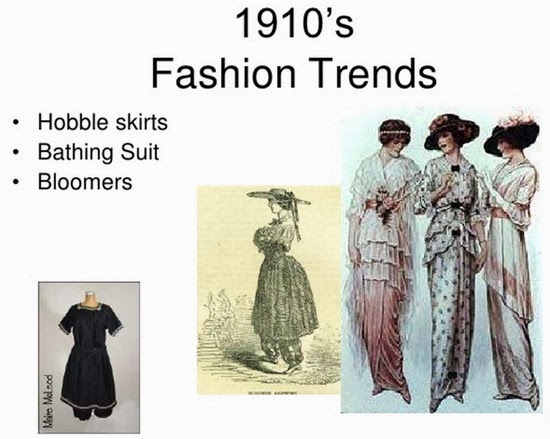
1910-1920, Women’s Fashion…
  • Shape and silhouette constantly evolved.
  • More radical styles like the hobble skirt and the lampshades skirts each enjoyed their moment in the sun.
  • The Edwardians became more playful and innovative, taking an interest in asymmetrical draping techniques.
  • V necks were very popular.
  • Soft lace blouses.
  • Peg top dress for pregnant women.
  • Considerably less boning was used in bodices and now solely for supporting the shape as opposed to changing it.
  • Suits were fashionable for day wear and walking was eased due to a really big fashion happening- the skirt hem rose to the ankle.

Vintage Hats & Headgear Fashion from the 1910s-1920s

Fashion…

1910-1920’s MEN’S FASHION….
  • The fashionable man in the early 1910’s was seen wearing a one or three button cut away frock coat or the double breasted sack which is straight lined jacket.
  • Average width of pants leg was whopping 22 inches at the bottom. It was a dandy type of look, the cane was standard the collar was high (usually with a bow tie) , a bowler or some type of hat was worn.
  • A man’s hat in those days was meant to coordinate with this outfit. A top hat in 1900 went with the frock coat, the homburg was necessary for less formal day wear and the straw hat was popular with both men and women. 


1920’S WOMEN’S FASHION….
  • During the early 1920s, waistlines were at the waist, but were loose and not fitted.
  • Women wore suits with long hemlines and somewhat full skirts, often with belts at the waist of the jackets. Dress and suit bodices alike were worn loose, even baggy.
  • By 1923, waistlines began to drop to a point between the natural waist and hips, while styles continued to be loose and baggy. In 1924 the waistline dropped to the hip.
  • In 1925, “shift” type dresses with no waistline emerged.
  • At the end of the decade, dresses were being worn with straight bodices and collars. Tucks at the bottom of the bodices were popular, as well as knife-pleated skirts with a hem approximately one inch below the knee.
  • In 1928, styles changed again! Hemlines rose to the knee and dresses became more fitted. These changes laid the foundation for the elegantly styled fashions of the 1930s. 

1920s FASHION 
 

1920’S MEN’S FASHION…
  • The late 1920s saw the adoption of two-toned spectators for men, perfect with the popular knickers.
  • In the 20s, men were still in a conservative mood.
  • The wide trousers were still worn, sometimes as wide as 24 inches at the bottom!.
  • The knickers and ‘plus fours’ were popular with sporty types, and were buckled 4” below the knee (hence the name ‘plus fours’).
  • Light colors were favored in summer, but darker and animal fur was favored when the weather got cold.
  • By now all the college boys were wearing the popular raccoon coat, and some of the women were too.