Halo Sobat ! | Members area : Register | Sign in
About me | SiteMap | Arsip | Terms of Use | Dcma Disclaimer

Footer

Powered by Blogger.

Social Icons

Featured Posts

Slider(Do not Edit Here!)

Minha lista de blogs

Publicidade 2

Cantinho do Blog

Parcerias

Hospedagens FREE

Dominios FREE

Publicidade 1

widget

Pojok Blog

Arsip

Sample text

Sample Text

Sample Text

Powered By Blogger
Powered By Blogger
Powered By Blogger

Perangkat SD

Perangkat SMP

Berita Pendidikan

Pengumuman

..::Aprendiz MUOnline::..

..::Ultimate Vendas::..

..::Central MU Online::..

..::Criando Portais::..

..::Viciados MU::..

..::Universe Divulgação::..

Visitor Counter

Google Search

..::Mixer Divulgação::..

You can replace this text by going to "Layout" and then "Page Elements" section. Edit " About "

..::Rádios Online::..

Recent Comments

..::Melhor Divulgação::..

..::Vermelho Divulgação::..

..::Extreme Divulgação::..

..::Control Downs::..

..::Divulgaçao::..

..::FreeXat parceiro top::..

..::Ciados MU Online::..

..::Nosso Banner no seu Site::..

About Me-

Seguidores

Seguidores

Social Icons

Musik

Translate

..::Majestic Hacker::..

..::Exclusivo MU Online::..

Translate to your language

Fox Life

Pages

Pages

Publicidade

Parceiros

Social Icons

Selling Brochure of Spirality Correction System Machine

Sunday, 9 February 2014

[Sponsored Article]
SPIRALITY CORRECTION SYSTEM (SCS)

SPIRALITY CORRECTION SYSTEM (Patent pending) is a fully automatic machine, made by Geo Energy Solutions P.C. and is used for controlling the remaining spirality of tubular knitted fabric.
Spirality Correction System Machine


Specifications:
  • Working width*:        12 inches - 24 inches (Type I SCS system)
                                     24 inches – 50 inches (Type II SCS system)
* Tubular fabric in flattened width.
  • Speed:                     10-60 m/min
  • Power:                     2KW
  • Driving method:        Frequency inverters
  • Detwisting method:   Automatic
  • Fabric input:             Flat form
  • Fabric output:           Flat form
Dimension:
  • Total Length:            3500 mm
  • Total Width:             2000 mm
  • Weight:                    400Kgr

You can Watch a Video of This Machine:


Contact Details:
Geo Energy Solutions P.C.
Industrial Area of Sindos,
57400 Thessaloniki, Greece.
Tel: 0030 22330 89575, Fax: 0030 22330 89576,  
E-mail: glev101960@gmail.com, info@levotex.gr

George Lagogiannis
Technical Director
Tel: 0030 6977 329894

Mazharul Islam Kiron
Country Representative
Cell: +88 01724 752452 
Dhaka, Bangladesh


Introduction:
The most important problem of tubular knitted fabric as it is being withdrawn from a circular knitting machine and especially of the single jersey structure is the remaining twist due to the fabric spirality.

Spirality can be defined as a fabric condition resulting when the knitted wales and courses are angularly displaced from that ideal perpendicular angle.

It occurs in knitted fabric because of asymmetric loops which turns in the wales and course of a fabric into an angular relationship other than 90 degree.

It may exist in grey, washed or finished state and presents a serious problem during garment confection and use.

Some of the practical problems arising out of the loop spirality in knitted garments are: mismatched patterns, sewing difficulties, displacement or shifting of side seams to the back and front of the body, garment distortion and inclined lines at striped fabrics.

Parameters that Influence Spirality:
  • The main source of spirality is yarn twist.
  • Spirality depends on feed density, machine cut, and loop shape, but the magnitude of spirality can be offset by the selection of yarn twist direction. In addition, reduction in yam “torque” can only partially reduce fabric spirality.
  • The right use of Z and S twist yarns is essential.
  • The number of feeders in a circular knitting machine influences the spirality angle.
  • The degree of fabric spirality increases linearly with stitch length.
  • Spirality also depends on textile dyeing and finishing process. After wet processing in rope form, the tubular fabric is collapsed and badly twisted. Most important the fabric during drying process in dryer machines, is relaxed and the spirality increases.
Until today It was very important to reduce fabric spirality from knitting process in order to make spirality correction during finishing possible.

The new SCS system reduces the remaining spirality to less than 4% working at the final finishing process prior to the packaging. This means that there is absolutely no way for the fabric to return to its previous twisted state.

The big advantage of SCS system is that works efficiently, regardless of all parameters that influence the spirality from knitting process to dyeing and finishing process.

How it Works:
It is set at the entrance of a compactor or a calender machine, working with automatic synchronization at the final operation prior to the packaging, reducing the processing time and cost.

The only needed data for input are the percentage of the spirality (determined by tumbler test), the width of the fabric and the direction of rotation.

The process is fully automated controlled by a PLC. The program can control the degree and direction of twist imparted by speeding up, slowing down, stopping the motor, or changing the direction of rotation.

The materials used for the construction of the mechanism are suitable for very little friction required to impart or retard twist to the traveling fabric. Therefore, such relatively smooth surfaces can provide sufficient friction for proper operation and do not snag or otherwise damage the finished product.

A safety shut-off device is also installed to prevent damage to the De-twisting mechanism and/or to the fabric, if a large hole in the fabric is detected. 

You can Read Also About: 
Spirality Correction System Machine

Analyzing the Possibility of Producing Plated and Fleecy Fabrics onFlat Knitting Machine

Tuesday, 4 February 2014

Introduction:
Plated fabrics can be knitted on flat knitting machines. Although there were several issues related to this matter previously, though it’s been over come from those matters nowadays

Knitting effect of weft plating was influenced by the yarn type, the knitting devices and the stitch structure.

The yarn type had a great influence on the plating effect. To obtain an attractive cover effect,
  • The face yarn should be thicker than that of the ground yarn.
  • Both the face and ground yarns should have a steady loop length
  • Diameter of the face yarn to the ground yarn should have the ratio of around 1.4 : 1.
In order to knit plated fabrics on flat knitting machines, there is a concept of a new plating yarn carrier with three guide eyes for a flat knitting machine. Using that new yarn carrier, a three-layer plated fabric also can be knitted other than two-layer plated fabrics. The concept of the design was that the laying lengthwise angle of the ground yarn should be greater than that of the face yarn, the laying lateral angle of the ground yarn should be smaller than that of the face yarn, and the laying position of the middle yarn should fall between these values. At the same time, the feeding tension of the ground yarn should be a little greater than that of the face yarn.

Design of the yarn carrier
The fabric structure was cotton yarn outside, Superfine polypropylene filament inside and Lycra in the middle. According to the conventional plating technique, the laying lengthwise angle and lateral angle of cotton should both be smaller than that of polypropylene, and the lycra should be in the middle. The laying position is shown in Figure 1 

There ‘d’ is poly­propylene, ‘e’ is lycra and ‘f’ is cotton. According to the new plating concept, the laying lengthwise angle of polypropylene should be greater than that of cotton, the laying lateral angle of polypropylene should be smaller than that of cotton, and that of Lycra should be between those values. The laying position is shown in Figure 1.b. This kind of laying position should ensure the cotton yarn enters the hook first and keeps steady. Then, the polypropylene filament enters the hook along with the closure of the needle latch. This guarantees that the yarn po­sition remains steady, and decreases the misplating problems.
Figure 1: Laying position
Configuration of the yarn carrier
The configuration of the yarn carrier is as shown in Figure 2. ‘a’ is the guide eye of the ground yarn, ‘b’ is the guide eye of the middle yarn and ‘c’ is the guide eye of the face yarn. The guide eye ‘a’ is fixed, but ‘b’ and ‘c’ can slide in the groove to change the laying lengthwise angle. (The unit is mm.)
Figure 2:Yarn carrier configuration
Laying position
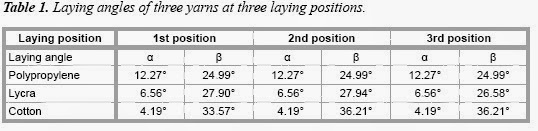
Laying position is the main factor affect­ing the plating result. Three laying posi­tions were done here. Table 1 gives the laying lengthwise angles and lateral angles of polypropylene, Lycra and cotton at three laying positions. α refers to the laying lengthwise angle and β refers to the laying lateral angle.
Conclusions
This yarn carrier with three guide eyes can knit three-layer plated fabric and effectively control the misplating problems. The design concept for the new yarn carrier was that the laying lengthwise angle of the ground yarn was greater than that of the face yarn; the laying lateral angle of the ground yarn was smaller than that of the face yarn, and the laying position of the middle yarn was between those val­ues. The feeding tension of the ground yarn was also a little larger than that of the face yarn.

Also we can make fleecy fabric using flat knitting machine because flat knitting machine is a versatile machine which can make any type of knitted fabrics that is producing any kind of fabric possible. But the production rate is the limiting factor.