Halo Sobat ! | Members area : Register | Sign in
About me | SiteMap | Arsip | Terms of Use | Dcma Disclaimer

Footer

Powered by Blogger.

Social Icons

Featured Posts

Slider(Do not Edit Here!)

Minha lista de blogs

Publicidade 2

Cantinho do Blog

Parcerias

Hospedagens FREE

Dominios FREE

Publicidade 1

widget

Pojok Blog

Arsip

Sample text

Sample Text

Sample Text

Powered By Blogger
Powered By Blogger
Powered By Blogger

Perangkat SD

Perangkat SMP

Berita Pendidikan

Pengumuman

..::Aprendiz MUOnline::..

..::Ultimate Vendas::..

..::Central MU Online::..

..::Criando Portais::..

..::Viciados MU::..

..::Universe Divulgação::..

Visitor Counter

Google Search

..::Mixer Divulgação::..

You can replace this text by going to "Layout" and then "Page Elements" section. Edit " About "

..::Rádios Online::..

Recent Comments

..::Melhor Divulgação::..

..::Vermelho Divulgação::..

..::Extreme Divulgação::..

..::Control Downs::..

..::Divulgaçao::..

..::FreeXat parceiro top::..

..::Ciados MU Online::..

..::Nosso Banner no seu Site::..

About Me-

Seguidores

Seguidores

Social Icons

Musik

Translate

..::Majestic Hacker::..

..::Exclusivo MU Online::..

Translate to your language

Fox Life

Pages

Pages

Publicidade

Parceiros

Social Icons

Some Essential Formula and Example for Industrial Engineer (IE)

Friday, 14 February 2014

Some Important Formula & Example for IE


   1. Standard Pitch Time (S.P.T) = Basic Pitch Time (B.P.T) + Allowances (%)
         
  • GSD = (Man power * Work hour) / Target          
  • SMV = Basic time + (Basic time * Allowance)          
  • Basic time = Observed time * Rating
  • Observed time = Total Cycle time / No of cycle
  • Rating = (Observed Rating * Standard rating) / Standard rating
  • Efficiency = (Earn minute * Available minute) * 100 
  • Earn minute = No of Pc’s (Production) * Garments SMV
  • Available minute = Work hour * Manpower
  • Organization Efficiency = (Basic pis time / Bottle neck time) * 100 
  • Basic pis time = Total GMT SMV / Total Manpower
  • UCL = Basic pis time / Organization Efficiency
  • LCL = 2 * Basic pis time – UCL
  • Capacity = 60 / Capacity time in minute
  • Cycle Time = 60 / Team target
  • Capacity Achievable = Capacity * Balance
  • Daily output = Work hour / SMV
  • Factory capacity = (Work hour / SMV) * Total worker * Working day * Efficiency
  • CPM = (Total over head cost of the month / No of SMV earners * Work minutes) *Efficiency
  • Required no of operator = Target daily output / Daily output per operator

Example:

1. Efficiency = Output/Input

                      = (SMV*Product Quantity) / (Worker*Working Hour*60)

                      = [(38.50*700) / (60*10*60)]*100 

                      = 74% (Line Efficiency)

Here,
SMV=38.50 
Working hour=10
No. of worker=60

2. Target/hour = (60/SMV)*Efficiency%

                        = (60/0.85)*70%

                        = 50 pcs/hour

Here,
SMV=0.85
Efficiency=70%

3. Target/line = [(No of worker*working hour*60)/SMV]*Efficiency%

                       = [(75*10*60)/23.5]*60%

                       = 1150 pcs

Here,
No of workers=75 
Working hours=10 
SMV=23.5 
Efficiency=60%

4. Required days for the schedule = Total order quantity/Average target

                                                         = 50000/2000 

                                                         =25 

Here,
Average target=2000 
Order quantity=50000 

5. CM of garments= (Total Production)/(no of worker*work hour)

                               = 250000/(1500*10)

                               =1.66 BDT

Here,
Total Production=250000 
No of workers= 1500 

6. Factory capacity = [(Work hour*total workers*working day*60)/SMV]*Efficiency

                                = [(10*1500*26*60)/14.13]*55%

                                = 828025 pcs/month


7. Line GSD/day = (Manpower*work hour)/target

                             = (50*10*60)/900 

                             = 33 

The Strategies View of Industrial Engineering and Its Discussion

Tuesday, 31 December 2013

The Strategies View of Industrial Engineering and Its Discussion

Rahamat Ullah Joy
B.sc in Textile Engineering
Daffodil International University
Facebook: Rahamat Ullah Joy
Email: rahamat.tex@gamil.com
Phone: +8801614445257


Introduction:
Industrial engineering (IE) is about choices. Other engineering disciplines apply skills to very specific areas. IE gives you the opportunity to work in a variety of businesses. The most distinctive aspect of industrial engineering is the flexibility that it offers. Whether it’s shortening a roller coaster line, streamlining an operating room, distributing products worldwide, or manufacturing superior automobiles, all share the common goal of saving money and increasing efficiencies.

The most distinctive aspect of industrial engineering is the flexibility it offers. Whether it’s shortening a rollercoaster line, streamlining an operating room, distributing products worldwide, or manufacturing superior automobiles, these challenges share the common goal of saving companies money and increasing efficiencies.

As companies adopt management philosophies of continuous productivity and quality improvement to survive in the increasingly competitive world market, the need for industrial engineers is growing. Why? Industrial engineers are the only engineering professionals trained specifically to be productivity and quality improvement specialists.

Industrial engineers figure out how to do things better. They engineer processes and systems that improve quality and productivity. They work to eliminate waste of time, money, materials, energy and other commodities. This is why many industrial engineers end up being promoted into management positions.

Many people are misled by the term industrial engineer. It’s not just about manufacturing. It also encompasses service industries, with many IEs employed in entertainment industries, shipping and logistics businesses, and healthcare organizations.

Many people are misled by the term “industrial engineer.” The “industrial” does not mean just manufacturing. It encompasses service industries as well. It has long been known that industrial engineers have the technical training to make improvements in a manufacturing setting. Now it is becoming increasingly recognized that these same techniques can be used to evaluate and improve productivity and quality in service industries.

What Does an Industrial Engineer Do?
Industrial engineers figure out ways to do things better. They engineer processes and systems that improve quality and productivity. IE’s make significant contributions to their employers by saving money while making the workplace better for fellow workers. In addition to manufacturing, industrial engineers apply their skills in a variety of settings.

Here are a few examples:
  • As a management engineer in a hospital, an IE may help doctors and nurses make the best use of their time in treating patients. 
  • As an ergonomist in a television manufacturing plant, an IE may change the tools workers use to assemble televisions to reduce the risk of repetitive stress injuries. 
  • As an operations analyst for an airline, an IE may design a bar coding system for identifying and transporting passengers luggage to ensure that it does not get lost. 
  • As a quality engineer for a public gas and electric company, an IE may improve customer satisfaction by designing a process to schedule service calls around the availability of the customer.
Manufacturing firms and service industries hire a significant number of IE’s. Today, more and more businesses hire IE’s in areas like sales and marketing, finance, information systems, and personnel. Other industries employing IE’s are hospitals, airlines, banks, railroads, and social services.

Industrial engineering has provided a systematic approach to streamline and improve productivity and efficiency in the business world.
  • IE’s provide leaner, more efficient, and more profitable business practices while increasing customer service and quality. 
  • IE’s make the work environment safer, faster, easier, and more rewarding. 
  • They provide a method by which businesses can analyze their processes and try to make improvements to them. Staying focused on optimization ‐ doing more with less ‐ which helps to reduce waste in society. 
  • IE’s help reduce costs associated with new technologies, thus allowing more of the population to better their lives by being able to afford these advances.

FIG : WORKING ARENA OF IE’S
Where Do Industrial Engineers Work?
Manufacturing firms and service industries hire a significant number of IE’s. Today, more and more businesses hire IE’s in areas like sales and marketing, finance, information systems, and personnel. Other industries employing IE’s are hospitals, airlines, banks, railroads, and social services.

MANAGE PROJECTS
  • Project Management
  • Project Scheduling
  • Risk Management
PROCESS IMPROVEMENT
  • Lean Manufacturing
  • Engineering Economic Analysis
  • Process Modeling
  • Root Cause Analysis
  • Statistical Methods
  • Six Sigma
  • Time Studies
  • Work Sampling
SUPPLY CHAIN ANALYSIS
  • Supply Chain Alignment
  • Material Logistic
  • Inventory Control
  • Supplier Support
  • Make/Buy Mfg Process
OPERATIONS IMPROVEMENT
  • Ergonomics & Human Factors
  • Operating Plans
  • Recovery Planning
  • Capacity Planning
INTEGRATED SYSTEMS
  • Value Stream Analysis
  • Facilities Layout
  • Production System Design
  • Manufacturing Process Design
  • Systems Thinking
DIRECT SUPPORT TO PRODUCTION
  • Production Scheduling
  • Theory of Constraints
  • Budgets & Forecasts
  • Crew Empowerment
  • Defect Analysis
  • Benchmarking Analysis
Why Choose Industrial Engineering?
Industrial engineering is a versatile and diverse discipline concerned with the design, analysis, and optimization of systems at both the process and enterprise level. But even that broad‐based statement doesn’t do justice to the range of problem‐solving skills that an industrial engineering education will provide. It’s a way of thinking, examining, and analyzing. It’s a way of finding the best solution to a situation.

Industrial engineers can go anywhere. Be anything. The possibilities are limitless.

Other criteria or site of IE’s

1. Industrial Engineer’s Job Profile
It was just a couple of years back that demand of an industrial engineer has increased many times. Reason, an Industrial engineer can do a lot to improve performance of the company

2. How to Calculate SAM of a Garment?
SAM or Standard Allowed Minute is used to measure task or work content of a garment. This term is widely used by industrial engineers and production people in the garment manufacturing industry. For the estimation of cost of making a garment SAM value plays a very important role

3. Comparison between Progressive bundle system and UPS system
In the industrial sewing plants various types of sewing systems are installed. A plant owner chooses these systems depending on the production volume, product categories, and cost effectiveness of high tech machineries. Among those “Progressive Bundle System” (PBS) is mostly installed sewing system till date.

4. How to calculate operator efficiency at work?
In apparel manufacturing, skills and expertise of a sewing operator is being presented in “Efficiency” term. An operator with higher efficiency produces more garments than an operator with lower efficiency in the same time frame. When operators work with higher efficiency, manufacturing cost of the factory goes down.

5. Can anybody hit 100% Efficiency of GSD(General sewing data ) SAM?
I have intentionally referred ‘GSD SAM’ because most of garment engineers, industry experts and business owners believe that GSD based standard minutes are more accurate than other. You may feel that what a silly question it is. But I met numbers of young industrial engineers, who ask me questions in the same way I have titled this article.

6. What is Productivity?
Productivity is a measure of the efficiency and effectiveness to which organizational resources (inputs) are utilized for the creation of products and/or services (outputs). Productivity measurement is both a measure of input utilization and an assessment as to whether or not input utilization is growing faster than output

7. KPIs for Garment Manufacturers
Key performance Indicators (KPIs) are measured to assess where the factory currently stands and to find key focus areas where management needs to look into. Top 9 KPIs has been listed and explained below that are measured by garment manufacturers (export houses) in the apparel industry.

Last Content:
Industrial engineering is best process to improve in any sector or industry to gain more profit but invest is low. When we discuss the ie then we must be follow the work study (http://textilelearner.blogspot.com/2013/11/an-overview-of-work-study-in-textile.html), time study, method study and motion study an industrial engineer must follow that criteria. and finally

IE’s make processes better in the following ways:

  • More efficient and more profitable business practices
  • Better customer service and product quality
  • Improved efficiency
  • Increased ability to do more with less
  • Making work safer, faster, easier, and more rewarding
  • Helping companies produce more products quickly
  • Making the world safer through better designed products
  • Reducing costs associated with new technologies
Reference:
  1. http://www.iienet2.org/details.aspx?id=716
  2. http://en.wikipedia.org/wiki/Industrial_engineering
  3. http://www.iienet2.org/uploadedFiles/IIE/Jobs/Jobs_Details/09PP104_RolesInIndustry_PowerPoint.pdf 
 

Primary/Basic Elements of Lean Manufacturing Process

Saturday, 21 December 2013

Lean Manufacturing:
Lean Manufacturing, or Lean Production, refers to a business concept wherein the goal is to minimize the amount of time and resources used in the manufacturing processes and other activities of an enterprise, with emphasis on eliminating all forms of wastage. It is basically the fusion of various management philosophies designed to make operations as efficient as possible. Business philosophies invoked by lean manufacturing include Just-in-Time (JIT) Manufacturing, Kaizen, Total Quality Management (TQM), Total Productive Maintenance (TPM), Cellular Manufacturing, and the like. The roots of lean manufacturing can be traced to Japan, or more specifically, Toyota.
Lean Manufacturing Process
Description of the Five Primary Elements of Lean Manufacturing:
The Five Primary Elements for lean manufacturing are
  1. Manufacturing Flow,
  2. Organization,
  3. Process Control,
  4. Metrics, and
  5. Logistics .
These elements represent the various facets required to support a solid lean manufacturing program, and it is the full deployment of these elements that will propel a company on a path toward becoming a world class manufacturer.

Following is a short description of each of the Five Primary Elements:


Manufacturing Flow:
The aspect that addresses physical changes and design standards that are deployed as part of the cell.

Manufacturing Flow
  • Product/quantity assessment (product group)
  • Process mapping
  • Routing analysis (process, work, content, volume)
  • Takt calculations
  • Workload balancing
  • Kanban sizing
  • Cell layout
  • Standard work
  • One-piece flow
Organization:
The aspect focusing on identification of people’s roles/functions, training in new ways of working, and communication.

Organization
  • Product-focused, multidisciplined team
  • Lean manager development
  • Touch labor cross-training skill matrix
  • Training (lean awareness, cell control, metrics, SPC, continuous improvement)
  • Communication plan
  • Roles and responsibility
Process Control:
The aspect directed at monitoring, controlling, stabilizing, and pursuing ways to improve the process.

Process Control
  • Total productive maintenance
  • Poka-yoke
  • SMED
  • Graphical work instructions
  • Visual control
  • Continuous improvement
  • Line stop
  • SPC
  • 5S housekeeping
Metrics:
The aspect addressing visible, results-based performance measures; targeted improvement; and team rewards/recognition.

Metrics
  • On-time delivery
  • Process lead-time
  • Total cost
  • Quality yield
  • Inventory (turns)
  • Space utilization
  • Travel distance
  • Productivity
Logistics:
The aspect that provides definition for operating rules and mechanisms for planning and controlling the flow of material.

Logistics
  • Forward plan
  • Mix-model manufacturing
  • Level loading
  • Workable work
  • Kanban pull signal
  • A,B,C parts handling
  • Service cell agreements
  • Customer/supplier alignment
  • Operational rules
These primary elements provide full coverage of the range of issues that surface during a lean manufacturing implementation. Each element focuses on a particular area of emphasis and compartmentalizes the activities. Even though each element is important on its own for the deployment of a successful lean manufacturing program, the power comes from integration of the elements. For instance, Manufacturing Flow sets the foundation for change. People see activity on the shop floor, furniture being moved (sometimes for the first time), machines or floors or walls being painted, and areas being cleaned up. Excitement and energy surround this visible change. Add to this the less than visible changes in infrastructure relative to organizational roles and responsibility, new ways of working, training of personnel, multi-function teaming, and identification of customer/supplier relationships.

Finally, add the visible presence of shopfloor measurements reflecting status, equipment being repaired, graphic work instructions being posted at work stations, and machine changeover times being recorded and improved. These primary elements complement one another and are all required to support each other as part of a successful implementation. Most lean manufacturing initiatives focus on the primary elements of Manufacturing Flow, some on Process Control and areas of Logistics.

Risks of Higher Productivity in Garment Industry

Sunday, 15 December 2013

What is LEAN?
LEAN is perhaps the most radical way of improving productivity. LEAN focuses on continuously improving the way a factory works, to make it ever more efficient.

Under LEAN, workers may be organised into ‘cells’. These are groups of workers trained in several skills who can make a whole product. Cells have production targets for the whole group rather than for individuals.
Workers in sleeping
This is different from the product being made on an assembly line, where workers with different skills each do a particular task.

LEAN is intended to change the culture of a factory as well as the physical way that the factory and workstations are organised.

The garment industry should focus and develop good working conditions to reduce the injuries created to their workers since there is ample room for ergonomic improvements in the clothing industry.

Who wants Higher Productivity?

If you are experiencing these kinds of changes in your workplace, your employer may be making them for his or her own reasons. Perhaps they think that the current ways of working are too slow, and lead to excessive overtime in your factory.

These changes may also be asked for by the buyer companies that place orders in your factory. In some cases, the buyers might be concerned about quality – perhaps they are having to return too many faulty garments to your factory. Some may be concerned about your factory failing to meet delivery dates. All these things can affect the buyer company’s profits.

Recently, some buyer companies have been trying to make sure workers get a higher wage. They claim that the best way to get higher wages is to make changes in the workplace to increase productivity.

The Risks for Workers
If workers don’t come together and get involved when management brings in major changes at your workplace to increase productivity, you could end up:
  • with job losses, leading to a smaller workforce
  • with a faster pace of work
  • with extra pay, but not in line with how much extra you are actually producing
  • working in an unsafe environment.
So let’s pause and think about this for a moment, as workers…

Calculating Labor Productivity
One of the arguments that buyers use in their negotiations with your factory management is that the ‘labour productivity’ or ‘line efficiency’ in your factory is too low. What do they mean by this?

In your factory, the workplace changes you identified earlier (see page 2) are usually carried out by industrial engineers – the so-called IE department. It is their job to maximise the number of garments produced in the time available.

You will probably have seen a board hanging up at the end of your assembly line, monitoring your output against a target, usually on a daily and hourly basis.

One of the tasks done by the IE department is to calculate the time taken to make a specific garment. This is usually called a SAM (Standard Allowed Minute), although some factories call this the Standard Minute Value (SMV).

SAM (or SMV) means the time (in minutes) that it takes a worker to complete a specific operation or produce a specific garment. The SAM is often calculated by using a stopwatch. Sometimes it’s done by looking at a special table of times that have already been calculated, for every task needed to make a garment.

Once the buyer company and employer know how long it takes a worker to complete a specific operation, they can compare this with other factories, or with a special table of times, to see how ‘productive’ workers are.

Techniques of Work Measurement and Their Applications

Friday, 13 December 2013

Work measurement (WM)

Work measurement is the application of techniques designed to establish the time for a qualified worker to carry out specified jobs at a defined level of performance.

Work measurement (WM) is concerned with investigating, reducing and eliminating ineffective time, whatever may be the cause.

WM is the means of measuring the time taken in the performance of an operation or series of operations in such a way that the ineffective time is shown up and can be separated out.

Work measurement is also called by the name ‘time study’. Work measurement is absolutely essential for both the planning and control of operations. Without measurement data, we cannot determine the capacity of facilities or it is not possible to quote delivery dates or costs. We are not in a position to determine the rate of production and also labor utilization and efficiency.

It may not be possible to introduce incentive schemes and standard costs for budget control.

Objectives of Work Measurement
The use of work measurement as a basis for incentives is only a small part of its total application.

The objectives of work measurement are to provide a sound basis for:
  1. Comparing alternative methods.
  2. Assessing the correct initial manning (manpower requirement planning).
  3. Planning and control.
  4. Realistic costing.
  5. Financial incentive schemes.
  6. Delivery date of goods.
  7. Cost reduction and cost control.
  8. Identifying substandard workers.
  9. Training new employees.
Techniques of Work Measurement
For the purpose of work measurement, work can be regarded as:

1. Repetitive work: The type of work in which the main operation or group of operations repeat continuously during the time spent at the job. These apply to work cycles of extremely short duration.

2. Non-repetitive work: It includes some type of maintenance and construction work, where the work cycle itself is hardly ever repeated identically.
Techniques of Work Measurement
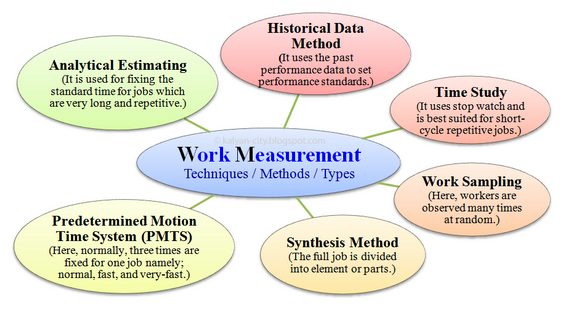
Various techniques of work measurement are:
  1. Time study (stop watch technique),
  2. Synthesis,
  3. Work sampling,
  4. Predetermined motion and time study,
  5. Analytical estimating.
Time study and work sampling involve direct observation and the remaining are data based and analytical in nature.

1. Time study: A work measurement technique for recording the times and rates of working for the elements of a specified job carried out under specified conditions and for analysing the data so as to determine the time necessary for carrying out the job at the defined level of performance. In other words measuring the time through stop watch is called time study.

2. Synthetic data: A work measurement technique for building up the time for a job or pans of the job at a defined level of performance by totalling element times obtained previously from time studies on other jobs containing the elements concerned or from synthetic data.

3. Work sampling: A technique in which a large number of observations are made over a period of time of one or group of machines, processes or workers. Each observation records what is happening at that instant and the percentage of observations recorded for a particular activity, or delay, is a measure of the percentage of time during which that activities delay occurs.

4. Predetermined motion time study (PMTS): A work measurement technique whereby times established for basic human motions (classified according to the nature of the motion and conditions under which it is made) are used to build up the time for a job at the defined level of performance. The most commonly used PMTS is known as Methods Time Measurement (MTM).

5. Analytical estimating: A work measurement technique, being a development of estimating, whereby the time required to carry out elements of a job at a defined level of performance is estimated partly from knowledge and practical experience of the elements concerned and partly from synthetic data.

The work measurement techniques and their applications are shown in Table.

Table: Work measurement techniques and their application
Techniques
Applications
Unit of measurement
1. Time study
Short cycle repetitive jobs.
Widely used for direct work.
Centiminute (0.01 min)
2. Synthetic Data
Short cycle repetitive jobs.
Centi minutes
3. Working sampling
Long cycle jobs/heterogeneous operations.
Minutes
4. MTM
Manual operations confined to
one work centre.
TMU (1 TMU = 0.006 min)
5. Analytical estimation
Short cycle non-repetitive job.
Minutes

Working Flow Chart of Method Study

Friday, 6 December 2013

Method Study:
Method study is the process of subjecting work to systematic, critical scrutiny to make it more effective and/or more efficient. It is one of the keys to achieving productivity improvement.

It was originally designed for the analysis and improvement of repetitive manual work but it can be used for all types of activity at all levels of an organization. Method study is essentially used for finding better ways of doing work. It is a technique for cost reduction.

The philosophy of method study is that ‘there is always a better way of doing a job’ and the tools of method study are designed to systematically arrive at this better way of doing a job.

Procedure Involved in Methods Study:

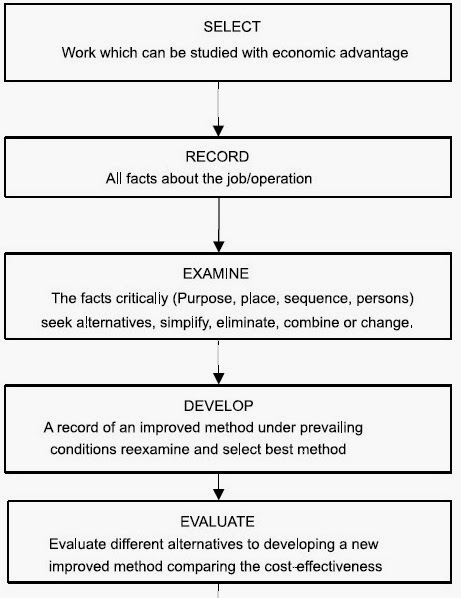
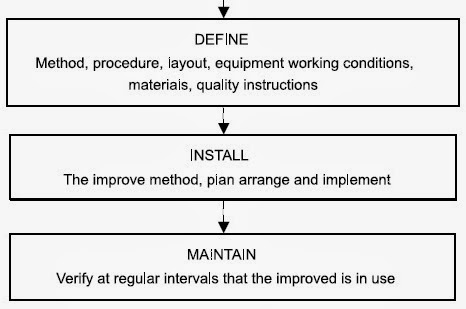
The basic approach to method study consists of the following eight steps. The detailed procedure for conducting the method study is shown in Fig.
Working flow chart of method study
1. SELECT the work to be studied and define its boundaries. The first step, once the Method Study idea is conceived, is the orientation and determination of objectives. The problem must be defined.

2. RECORD the relevant facts about the job by direct observation and collect such additional data as may be needed from appropriate sources. When the job has been selected for Method Study, the next step is to collect and record all the relevant data. The facts collected about the existing method are subsequently subjected to a thorough examination with a view to evolving improved methods. Hence, a clear and precise record is necessary, if method study is to be effective.

3. EXAMINE the way the job is being performed and challenge its purpose, place sequence and method of performance.

4. DEVELOP the most practical, economic and effective method, drawing on the contributions of those concerned.

5. EVALUATE different alternatives to developing a new improved method comparing the cost-effectiveness of the selected new method with the current method with the current method of performance.

6. DEFINE the new method, as a result, in a clear manner and present it to those concerned, i.e., management, supervisors and workers.

7. INSTALL the new method as a standard practice and train the persons involved in applying it.

8. MAINTAIN the new method and introduce control procedures to prevent a drifting back to the previous method of work.

It has been proved that the adoption of such a procedure ensures that no significant point is overlooked and helps in achieving maximum possible results.

Product Life Cycle | Stages and Limitations of Product Life Cycle (PLC)

Monday, 2 December 2013

Product Life Cycle

Product life cycle is a business analysis that attempts to identify a set of common stages in the life of commercial products. In other words the ‘Product Life cycle’ PLC is used to map the lifespan of the product such as the stages through which a product goes during its life span.
Graph of Product Life Cycle
Product life cycle is the course of a product’s sales and profits over time.

Product life cycle (PLC) deals with the life of a product in the market with respect to business or commercial costs and sales measures.

The five stages of each product lifecycle are product development, introduction, growth, maturity and decline.

A company’s positioning and differentiation strategy must change as the product, market, and competitors change over the product life cycle(PLC)

When we say that a product has a life cycle we assert four things:
  1. Products have a limited life.
  2. Products sales pass through distinct stages, each posing different challenges, opportunities and problems to the seller.
  3. Profits rise and fall at different stages of the product life cycle.
  4. Products require different marketing, financial, manufacturing, purchasing, and human resource strategies in each life – cycle stages.
Product Life-Cycle Strategies
The Product Life Cycle (PLC) has Five Stages
  1. Product Development, 
  2. Introduction, 
  3. Growth, 
  4. Maturity, 
  5. Decline
Not all products follow this cycle: The product life cycle concept can be applied to a:
  • Product class (soft drinks)
  • Product form (diet colas)
  • Brand (Diet Dr. Pepper)
Using the PLC to forecast brand performance or to develop marketing strategies is problematic

Product development
  • Begins when the company develops a new-product idea
  • Sales are zero
  • Investment costs are high
  • Profits are negative
Introduction
  • Low sales
  • High cost per customer acquired
  • Negative profits
  • Innovators are targeted
  • Little competition
Grouth
  • Rapidly rising sales
  • Average cost per customer
  • Rising profits
  • Early adopters are targeted
  • Growing competition 
Marketing strategies for Growth stage
During the growth stage, the firm uses several strategies to sustain rapid market growth.
  • Improves product quality and adds new features and improved styling.
  • Adds new models and flanker products(i.e., products of different sizes, flavors, and so forth that protect the main product).
  • It enters new market segments
  • It increases its distribution coverage and enters new distribution channels.
  • It shifts from product- awareness advertising to product- preference advertising.
  • It lowers price to attract the next layer of price – sensitive buyers. 
Maturity
  • Sales peak
  • Low cost per customer
  • High profits
  • Middle majority are targeted
  • Competition begins to decline 
Marketing strategies for Maturity stage
Three potentially useful ways to change the course for a brand are market, product, and marketing program modification.

Market Modification
  1. Sales volume = no. of brand users * usage rate per user.
  2. Expand the no. of brand users
  3. Convert nonusers
  4. Enter new market segments
  5. Attract competitors’ customers
  6. Increase the usage rate among users
  7. Have consumers use the product on more occasions.
  8. Have consumers use more of the product on each occasion
  9. Have consumers use the product in new ways.
Product modification
Trying to stimulate sales by modifying the product’s characteristics through

Quality improvement:
Aims at increasing the product’s functional performance.

Eg: Aashirvaad, Annapoorna, Pillsbury, Naturefresh

Feature improvement
Aims at adding new features, such as size, weight, materials, additives, and accessories, that expand the product’s performance, versatility, safety, or convenience.

Style improvement
Aims at increasing the product’s esthetics appeal.

Eg; New car models, New Coke 
 
Decline:
  • Increase investment
  • Resolve uncertainties - stable investment
  • Selective niches
  • Harvesting
  • Divesting
  • To establish a system for identifying weak products.
  • Some firms’ abandon declining markets earlier than others.
Limitations of Product Life Cycle (PLC)
Product life cycle is criticized that it has no empirical support and it is not fruitful in special cases. Different products have different properties so their life cycle also vary. It shows that product life cycle is not best tool to predict the sales. Sometimes managerial decisions affect the life of products in this case Product Life Cycle is not playing any role. product life cycle is very fruitful for larger firms and corporations but it is not hundred percent accurate tool to predict the life cycle and sales of products in all the situations.
 

Concept of New Product Development

Sunday, 1 December 2013

PRODUCT DEVELOPMENT CONCEPT
The product idea concept is first developed from market and consumer research but with consideration of the technical aspects of the product. Usually, it is a combination of internal company information searching combined with consumer or, in industrial marketing, customer discussion groups. In industrial product development, it has been shown that selecting the most innovative customers for product concept development reduces the time and improves the product concepts. The product idea concept research leads to a more detailed description of the product ideas and also includes screening of the ideas.

Product Development is the design and engineering required to make products serviceable, salable, producible and profitable.

The basic concept involved in PD may be of two types:
  1. Creative
  2. Technical
  • Creative design focuses on analysis and creativity.
  • Technical design which involves perfecting the style, fit and patterns and developing detailed specifications and costs.
  • The product can either be one that is new in market or one that is new to your particular company or existing product that has been improved.
Why develop New Product?
  • To create stars and cash cows for the future
  • To replace declining product
  • To take advantage of new technology
  • To defeat rivals
  • To maintain/increase market share
  • To keep up with rivals
  • To maintain competitive advantage
  • To fill gap in the market
PRODUCT DEVELOPMENT CONCERNS?
Management, Designers, Merchandisers are involved in the development of a line or collection of the fashion manufacturer’s product.

PRODUCT DEVELOPMENT PROCESS:
Apparel product development involves three phases:
  • Pre-adoption
  • Line-adoption
  • Post-adoption
Pre-adoption

1. This phase involves:
  • Design Features
2. Design development through sketching, draping and CAD.

3. CAD system allows trial and error in developing concepts for approval without having to sew physical samples.

4. Design process may be conducted simultaneously in different sequences to reduce time for the product development.

5. Design may be original ,draw on fabric, stored in computer or given by the consumer.
  • Piece Goods
6. Fabric selection. Material testing for performance.

7. In the pre-adoption phase it is make sure that the fabric or other materials that we are going to use would be available in large quantity for production.
  • Trims
8. Accessories selection and testing if required.

9. The accessories and trims that are going to be used in the garment must be available.

Line-adoption
1. This phase involves:
  • Integration of line development and line presentation
2. Planning a Collection
3. Developing a Collection (Design Development)
  • Developing a sample garment
  • Preparation of sales samples
Post-adoption
Which designs will become styles in the line and how the styles relate to the line planning?
This phase involves:
  • Perfect Styling and Fit.
Because sometimes the fitness present in the sample cannot be achieved in the production process.
  • Engineering production patterns.
  • Assembly methods (to check the suitability in production.
  • Developing Styles.
  • Quality specifications.
  • Estimate detailed costs.
  • Estimate the operation cost.