Halo Sobat ! | Members area : Register | Sign in
About me | SiteMap | Arsip | Terms of Use | Dcma Disclaimer

Footer

Powered by Blogger.

Social Icons

Featured Posts

Slider(Do not Edit Here!)

Minha lista de blogs

Publicidade 2

Cantinho do Blog

Parcerias

Hospedagens FREE

Dominios FREE

Publicidade 1

widget

Pojok Blog

Arsip

Sample text

Sample Text

Sample Text

Powered By Blogger
Powered By Blogger
Powered By Blogger

Perangkat SD

Perangkat SMP

Berita Pendidikan

Pengumuman

..::Aprendiz MUOnline::..

..::Ultimate Vendas::..

..::Central MU Online::..

..::Criando Portais::..

..::Viciados MU::..

..::Universe Divulgação::..

Visitor Counter

Google Search

..::Mixer Divulgação::..

You can replace this text by going to "Layout" and then "Page Elements" section. Edit " About "

..::Rádios Online::..

Recent Comments

..::Melhor Divulgação::..

..::Vermelho Divulgação::..

..::Extreme Divulgação::..

..::Control Downs::..

..::Divulgaçao::..

..::FreeXat parceiro top::..

..::Ciados MU Online::..

..::Nosso Banner no seu Site::..

About Me-

Seguidores

Seguidores

Social Icons

Musik

Translate

..::Majestic Hacker::..

..::Exclusivo MU Online::..

Translate to your language

Fox Life

Pages

Pages

Publicidade

Parceiros

Social Icons

Study on Merchandiser and Merchandising in Apparel Industry

Wednesday, 18 December 2013

An Overview of  Merchandiser and Merchandising in Garment Industry
Harshani Wijendra
Sri Lanka Institute of Textile & Apparel Technology (SLITA)
Email: harshani_bipasha@yahoo.com


Introduction:
In the broadest sense, merchandising is any practice which contributes to the sale of products to a retail consumer. At a retail in-store level, merchandising refers to the variety of products available for sale and the display of those products in such a way that it stimulates interest and entices customers to make a purchase.

In retail commerce, visual display merchandising means merchandise sales using product design, selection, packaging, pricing, and display that stimulates consumers to spend more. This includes disciplines and discounting, physical presentation of products and displays, and the decisions about which products should be presented to which customers at what time.

Definition for Merchandising:
“The activity of promoting the sale of goods, especially by their presentation in retail outlets.”
In the broadest sense, merchandising is any practice which contributes to the sale of products to a retail consumer. At a retail in-store level, merchandising refers to the variety of products available for sale and the display of those products in such a way that it stimulates interest and entices customers to make a purchase. In retail commerce, visual display merchandising means merchandise sales using product design, selection, packaging, pricing, and display that stimulates consumers to spend more. This includes disciplines and discounting, physical presentation of products and displays, and the decisions about which products should be presented to which customers at what time.
What is Merchandising?
Merchandising activities may include display techniques, free samples, on-the-spot demonstration, pricing, shelf talkers, special offers, and other point-of-sale methods. According to American Marketing Association, merchandising encompasses “planning involved in marketing the right merchandise or service at the right place, at the right time, in the right quantities, and at the right price.”
Apparel Industry
In Eastern Europe, particularly in Russia, the term “merchandising” is commonly used within the trading industry and denotes all marketing and sales stimulation activities around PoS (point of sale): design, creation, promotion, care and training of the sales staff. A merchandiser is someone who is continuously involved in business promotion by buying and selling of goods. In Asian countries, such as India, this term is more synonymous with activities right from sampling and idea conception to dispatching of the shipment. It is a job description that involves leading and working with different departments within the organization, suppliers and buyers to deal with timely deadlines and accepted quality levels.

Merchandiser Responsibilities:
The person who is related in merchandising is called merchandiser. The merchandiser coordinates with the design team to effectively present the product or product line. He or she develops colors and specifications, and performs market research to determine the most effective ways to sell and promote the product. This person needs strong communication and negotiation skills and visual and analytical abilities. He or she also needs to be a creative and innovative thinker. He should plan the activities to execute and dispatch the merchandise on time taking into consideration the 4 R’s of expediting Right Quantity, Right Quality, Right Cost & Right Time.
  1. Right Quantity: To dispatch right quantity of product what buyer ordered?
  2. Right Quality: It should be with right quality as accepted both parties.
  3. Right Cost: Everybody wants more from what they are paid.
  4. Right Time: No one wants to wait idle even in a Restaurant. Keeping delivery schedule is mandatory.
A Merchandisers Key Responsibility is as follows:
  • Product Development
  • Market and product Analysis
  • Selling the concept
  • Booking orders
  • Confirming Deliveries
  • Designing and Sampling
  • Costing
  • Raw Material
  • Flow Monitoring
  • Production Follow Ups
  • Payments Follows
  • Internal & external communication,
  • Sampling
  • Lab dips
  • Accessories & trims
  • Preparing internal order sheets
  • Preparing purchase orders
  • Advising and assisting production,
  • Advising quality department about quality level
  • Mediating production and quality departments
  • Giving shipping instructions and following shipping,
  • Helping documentation department
  • Taking responsibility for inspections and
  • Following up the shipment.
Qualities of Merchandiser:
Planning Capability: Merchandiser should be capable of planning, based on the planning the order is to be followed. If the planning is not done properly it will directly affect the delivery time of the order.

Decision making: For a Merchandiser, decision making power is most important. He should think about the decision to be taken and to act in a right way.

Communication Skill: The communication is very much important to promote the business activity. The merchandiser should remember that communication must be lurid and should having face to face conversation with the buyer.

Loyalty: Loyalty is an essential character of human beings. Especially for the business people like merchandiser it is a must.

Knowledge about the field: Merchandiser should have adequate knowledge about the garments, Computer knowledge, and technical knowledge to communicate with different people in the business is a must.

Co-ordinate & Co-operate: Merchandiser is the person who is actually co-ordinate with the number of departments. To Co-ordinate with different people in the industry he should be co- operative.

Monitoring ability: Merchandiser should monitor to expedite the orders.

Other qualities: Education, Experience, Situational Management, Ability to Evaluate, Dedication, Knowledge of expediting procedures.

Why Merchandising?
“The difference between marketing and merchandising is evident. One is an extension of the other. When one markets an item it is being offered for sale; when one merchandises that product, it is spotlighted, promoted, and enhanced to eventuate the fruition of the initial goal of the marketing of that item.”
                                            - Morris H. Kushner - Morris H. Kushner on Specialty Foods

“Advertising moves people toward goods; merchandising moves goods toward people.”
                                                                     - Morris Hite

As in the above sayings by Mr. Morris who is an Author & by Mr.M.Hite who is Morris Hite was a classic American advertising man, self-educated and self-made, nowadays a merchandiser’s role is very important. Without a merchandising strategy, products on the store shelf are left to fend for themselves among a sea of competing products. With the help of a carefully formulated merchandising strategy, retail marketers can highlight the unique value and benefits of a featured brand to attain the status of a category leader.

Why Merchandising is a important part of the marketing plan, and should have a reasonable budget allocated - even for a retailer operating on a shoestring. In today’s competitive retail environment a retailer cannot afford to consider merchandising as a ‘frill’. Everyone is competing for the customers’ dollar. There are more choices out there for consumers than ever before. So the competition in the market is more than years before. Therefore Merchandising plays a good role in the role of marketing.

The Roll of a Merchandiser……..
Is a massive, contrast with many responsibilities & working performances. Think of it this way, a product is manufactured and then sold to the public. Manufacturers are the ones who physically make the products that will be later sold. Merchandisers or Retailers are the ones who buy those manufactured products and sell them to their customers. Merchandisers are the middle man between the buyer and manufacturer… buyer wants to the product to produce and select the raw material of the cost of product. Totally all work to be carried and handle the only one person.

Typically, the role of a divisional merchandise manager, immaterial of the size of the retail organization, would involve the following functions:

1) Forecasting sales for the forthcoming budget period: This involves estimating consumer demand and the impact of changes in the retail environment.

2) Translating the sales forecast into inventory levels in terms of rupees. To do this effectively, the DMM needs to understands and provide for the inventory levels that would be needed to achieve of sales

3) Inspiring commitment and performance on the part of the merchandisers and buyers: Typically, as divisional merchandise managers are senior within the organization, it is believed that they can guide the merchandisers in terms of vendor selection, merchandise lines that can be developed and future trends.

4) Assessing not only the merchandise performance but also the buyer’s performance in order to provide control and maintain high performance results.

The roles of a merchandiser may differ from organization to organization. This article will give you an idea how a merchandiser work in the industry.

The Merchandiser usually works with all departments in a company—- management, design, sourcing, production and sales to make sure the finished product is executed correctly and on time. The merchandiser should have enough knowledge for determining the target population, researching the market for current trends and predicting future trends. Merchandisers works with management and sales to develop a line plan and makes sales projections for each season. The merchandising department also supervises the creation of selling aids i.e. salesman samples, swatch booklets, colour cards etc. In few companies the Merchandiser is required to give presentations to the sales force to familiarize them with the concepts of the line to help them pitch to retailers. In a large company a merchandiser or design director will head up this area with the help of one or more assistants. In a small company, the owner or designer will see to these responsibilities.

Execution of Garment Export Order

Tuesday, 3 December 2013

Execution of Garment Export Order

Md. Ferdus Alam
Department of Textile Engineering
Southeast University
Mobile: 01925419270 
Email: Ferdus.j@gmail.com
Facebook: Ferdus Alam


Steps of Garments Order Execution
Steps of garments order execution are described as follows:

1. Enquiry of a product:
First of all, supplier collects the product from the buyer and enquiry the product.

2. Lead time/Space Availability:
Lead time is time difference between buyer order confirmation date, date and delivery date. Within the time, garments must be delivery.

3. Costing:
Costing means the way of calculating the cost of production of garments. Costing is done considering-
  • Fabric price
  • Accessories price &
  • Cost of Making
4. Order Confirmation:
An order confirmation is a written confirmation which is issued by buyer to the manufacturer. It serves as tool to avoid confusion and mistakes in case order does not confirm to the original offer.

5. Purchase Order(P.O):
A buyer generated document that authorizes a purchase transaction. It includes description of product, quantities, prices, discounts, payment terms, date of shipment etc.

6. Guarantee of payment:
a. Telegraphic Transfer (T.T)
  • It is cash payment. Now it is not use.
b. L/C (Master) provided by buyer
  • L/C or Letter of Credit is a document which prepared by buyer to the manufacturer.
7. T & A calendar Making:
T & A or “Time and Action” calendar is made by the manufacturer to complete the production within a specific period of time.

8. Fabric & Accessories Booking:
After making of T & A calendar, fabric & accessories booking is necessary.
Without fabric, all materials used in garments are called “Accessories” or “Trimmings”.

9. Back to Back L/C:
Back to Back L/C is issued on the strength of master L/C. It is issued by the export’s bank to the supplier to produce raw materials. It has 70-80% financial value of Master L/C.

10. Sampling:
The process of collecting or making sample is called “Sampling”.

Types of Garments Sample

a. Proto Sample:

Features:
  • These samples are made by the manufacturer by available fabric and accessories.
  • These samples are made before or after order confirmation.
Purpose:
By These samples buyer checks whether or not the factory can make the garments.

b. Fit Sample:

Features:
  • These samples are made by the manufacturer by available fabric and accessories.
  • These samples are made after order confirmation.
Purpose:
By These samples buyer checks the fitness or measurement of the garments.

c. Pre-Production (P.P) Sample:

Features:
  • These samples are made by the manufacturer by actual fabric and accessories.
  • These samples are made after order confirmation.
Purpose:
Buyer will do bulk production following P.P sample.

d. Size Set Sample:

Features:
  • These samples are made in all sizes.
  • These samples are sent to the buyer.
  • These samples are made in the production floor.
Purpose:
These samples are made only for PP meeting or internal purpose.

e. Production Sample:

Features:
  • These samples are collected from the production floor while bulk production is running.
  • These are sent to the buyer.
Purpose:
By these samples buyer compares Production Sample with the P.P Sample.

f. Garments Test Sample:

Features:
  • These samples are collected from the production floor while bulk production is running.
  • These are sent to the testing house.
Purpose:
By These samples Testing House tests different aspects of the garments and sends “test report” to the buyer and factory.

g. Shipment Samples:

Features:
  • These samples are not so mandatory.
  • These are sent to the buyer after the shipment of the products.
Purpose:
By These samples buyer compares the Production Sample with the Shipment Sample.

11. Fabric & Accessories in House:
Here confirms all fabrics and accessories in their hand.

12. Inspection of the inventory & Report Making:
Check the quality & quantity of fabrics and accessories in house. After checking a report is made with the test data.

13. Pre-Production (P.P) Meeting:
This meeting is held just before going to the bulk production. This meeting is conducted by following persons-
  • Buying House QC
  • Factory QC
  • Buying House Merchandiser
  • Factory Merchandiser
  • Cutting Master
  • Pattern Master
  • Production Manager
  • Sample man
14. Pattern & marker making for bulk production:
Pattern is a hard paper which is made by following each individual component for a style of garments. Marker is a thin paper which contains all components of different sizes for a particular style of garments.

15. Trial or pilot Cutting:
Little amount (for 200-300 pieces of garments) of fabrics are cut for checking the efficiency and production cost of the garments.

17. Bulk Cutting:
Here total fabrics required for bulk production are cut.

18. Numbering, Bundling & Sorting:
After cutting of fabrics numbering, Bundling and sorting process are done. Then cut pieces are sent to the sewing section.

17. Production Line Set-up:
Production line set-up is the arrangement of sewing machines where the input of the first machine is cutting part of the fabrics and the output of the last machine is complete garments.

18. Sewing:
Cutting pieces are attached by sewing to make the complete garments. Different types of sewing machines are used in production line.

19. Finishing:
Finishing includes ironing, packing, cartooning etc.

20. Pre-Final Inspection:
This type of inspection is done only by factory Q.C. It may be at the end of the production line.

21. Final Inspection:
Final inspection is conducted by the –
  • Buyer
  • Buyer Q.C
  • Trader Q.C
  • Self-Inspection: Conducted by the factory Q.C.
  • Third Party Inspection: Conducted by the testing houses.
22. Delivery:
If everything is ok, then supplier sent the goods to the buyer.

Role of Merchandiser in Apparel Industry

Saturday, 12 October 2013

ROLE OF MERCHANDISER IN GARMENT INDUSTRY

Prashant G. Khandalkar
DKTE’s Textile & Engg. Institute, Ichalkaranji, 
Maharashtra, India
Email: prashantkhandalkar007@gmail.com


1. INTRODUCTION:
Merchandiser is the BRIDGE between the industry and the buyer. He have to look after every job like buying the raw material which is required to finish the product, making the garment, finishing the garment, documentation, finally shipping. He is the responsible person to make the product. A garment export unit generally has many department like stores, cutting, production, packing, checking etc. in which Merchandising department a linking device of all. The job of a merchandiser is to co ordinate with the entire department in the office as well as the customers. The merchandiser is the one who creates a good relationship in between exporter & buyer.
Apparel Industry
Merchandising is a specialized management functions within the fashion industry. It is the business that moves the world fashion from designers showroom to retail sales floor and in to the hands of consumers. It is the internal planning that takes place within a retail organization in order ensures adequate amount of merchandise are on hand to be sold at prices that the consumers are willing to pay to ensure a profitable operation.

Following are the responsibilities of merchandisers which gives importance to them;
  • Internal & external communication,
  • Sampling,
  • Lab dips,
  • Accessories & trims,
  • Preparing internal order sheets,
  • Preparing purchase orders,
  • Advising and assisting production,
  • Advising quality department about quality level,
  • Mediating production and quality departments,
  • Giving shipping instructions and following shipping,
  • Helping documentation department,
  • Taking responsibility for inspections and
  • Following shipment.
2. EVALUATION OF MERCHANDISER IN GARMENT:
The concept of term “Merchandising” can be traced dated back from the early historic period when the emergence of the trade between the countries. There are numerous notes about the existence and evolution of trade between the bigger civilizations in those periods like Greek, Roman, Indian, Chinese, and Egypt .But during those days the meaning of the term merchandising confined merely to exchange of materials or commodities which were availed from nature or produced from nature and they were not manufactured for specific purpose or specific customers. There was exchange of materials which fulfills the basic needs of living like commodities, live stocks, textiles and luxurious items like gold diamonds, precious stones etc…Earlier days the production of goods was home based and family oriented which were not mass produced. In the industrial period, home production was replaced by factory system and hand operations were replaced by machines. Mass productions were followed by large-scale consumption.

The term “Merchandising” got its significance after the industrial revolution that emerged during the 20th century after World War 2 and particularly during the period when there was a dramatic shift from Custom Made Tailoring to Ready Made Garments. During this period there was great demand for product development. Merchandising evolved as a bridge between the design and sales to fill the needs. It got its further momentum when the market concept which give more impotence to the customer needs, emerged in the industry.

The period between 1960 and the early 2000 saw dramatic changes in the structure, focus and content of apparel companies particularly in U.S. During 1970’s there was a remarkable growth surge to the apparel industry which continued trough the 1980 and 1990. United States played a major role in the evaluation of merchandising in apparel industry.

The necessity of merchandising lies essential due to the following factors:
  1. Dramatic growth,
  2. Complicated raw material & process,
  3. Complex network,
  4. Advent of new styles,
  5. Reduced Product Life Cycle,
  6. Textile innovations,
  7. Computer applications,
  8. Global transition
To achieve this level of different control while developing, executing and delivering a product line that meet the rapidly changing needs of target market, it requires a very special management professional which considered being a “Merchandising profession”.

3. TYPES OF MERCHANDISERS:
Types of Merchandiser
3.1 FASHION MERCHANDISER:
Fashion merchandising involves all the activities starting from the fashion forecasting, design and product development till to retail sales and this also include production merchandising and retail merchandising. This will be taken care by the buyer’s part. Fashion merchandise includes items of retail merchandise which have decorative value either with or without also having functional value. Fashion merchandise includes mostly item of apparel since they can all be decorative and functional.

Fashion merchandising refers to all the planning and activities involved in bringing the right fashion merchandising at the right place at the right time with right quantity at the right price and with right sales promotion. The fashion apparel world exists between the designer and the retail customer. The field of fashion merchandising exists to service the designer –customer relationship.
Fig 2: Process flow of fashion merchandiser
Steps are elaborated as fallows;

Fashion Forecasting: It shows or direct the company new fashion presentation for the upcoming season, so that it can understand the new fashion concept, the store‘s Merchandising approach and better help to their customer. Generally fashion prediction is done by the fashion direction in case of big organizations and by owner himself in case of small organizations.

Design development: The design is developed based on themes using the element s of design such as color, texture, line, shape and fabrication and adopting the principle of fashion such as proportion, balance, rhythm, emphasis and harmony. The design development should be practical which suits the current trends & also feasible to convert into the finished product. Design development is mainly done on the requirement of number of lines and groups that are going to be offered by the company for the particular season.

Sample development: The collection of design created by the designers, the design which are having good potential are selected and taken for sample development.

Product specification: this information of will be useful in setting the product specification for the particular garment. A product specification will guide the production department to develop and plan their merchandising and production planning and organize the thing for effective and efficient production of the merchandise.

Merchandising plan or policy: a fashion merchandising plan or policy is a long –range standard for fashion buying and selling as well as for related activities like sales promotion. Merchandising plans are planned several months before the selling season.

Assortment planning: A merchandise assortment is a collection of various types, quantities and price of related merchandise usually grouped under one classification within a department. A good assortment keeping will appeal a particular group of customers.

Buying: It is a very crucial activity of the fashion merchandising because this is the actual process of manufacturing the good and bringing them for the sales at retail stores. A buyer’s responsibilities include both the buying and selling aspects of retailing.

3.2 APPAREL EXPORT MERCHANDISING: 
Apparel export merchandising may be defined as ‘all the planning & activities involved right from the buyer  communication & order receiving till the execution or shipment of the order by fulfilling the following factors (Six Rights):

Right Merchandise: Retailers must fill their shelves with the merchandise that customer wants.

Right Place: The location of the merchandise is of prime importance since it decides the accessibility. Much merchandise is seasonal in nature and must be on hand when it is most needed.

Right Time: Much merchandise is seasonal in nature and must be on hand when it is most needed.

Right Quantity: A profitable balance between volume of sales and amount of inventory is the desired goal.

Right Price: Merchandiser must arrive at a price that is high enough to give the store profit and yet low enough to meet the competition and customers expectations.

Right Promotion: Right balance between the investment and the appeal created for the customers.
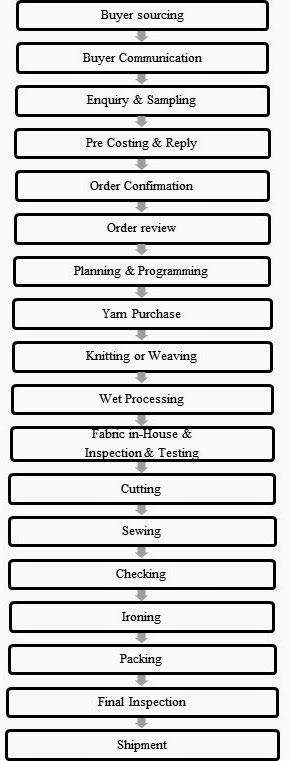
Fig 3: Process flow in Apparel industries
The successful execution of any garment export order depends on the work performance of a merchandiser. Merchandiser is the person who plans and coordinates all the activities right from the order procuring and till the shipment order. A merchandiser should have the comprehensive knowledge of his work procedures and responsibilities so that he could perform his job efficiently and effectively. In the apparel export industry, a merchandiser has to perform the following functions;

Communication: It is one of the foremost functions of merchandiser because the merchandiser has to communicate with different levels of people in his day to day activities.

Planning & Programming: A merchandiser has to check the order requirement, planning for the given order, programming for various activities, proper allocation of work to the assistants.

Follow ups: It includes sending of samples at various stages of order, buyer and buyer house for sample and other approvals.

Decision making: A merchandiser has to make several decisions during the order processing like giving approvals like fabrics, color, design, accessories, and packing, selection of suppliers and vendors, selection of buyers, sometimes time extensions for order shipment.

Sourcing & Purchasing: A merchandiser may have to do sourcing and purchasing for raw materials and accessories, suppliers and vendors, new designs, new buyers.

Controlling: This is the crucial activities for any merchandiser. A merchandiser has to make sure that all the activities are carried out as per the planning and even if there is any deviation, he/she should make the alternatives measures.

Coordination: Merchandiser has to coordinate in such way to reduce the uncertainties and difficulties and if there is a problem arises, the merchandiser has to support and lend helping hand in order to complete the task successfully in the given period. Both the controlling and coordinating activities complement each other and a merchandiser has to adopt the both accordingly,

Negotiation: It is the activity of convincing, compromising and cooperation which would benefit the both parties involved in the negotiation.

Costing: It is the process of estimating the expenditure of a given product and the subsequent price. It is another crucial function because mostly order conformation depends on the price offered to the buyers. The merchandiser should know the current prices and rates of various products and processes to do the accurate costing.

Meeting: There are two types of meeting a merchandiser has to be involved. First type, a merchandiser has to conduct the meeting with the concern department in charges to discuss about the proceedings and the status of the running order. In second type, a merchandiser has to attend the meeting with the superiors or buyers or business people in giving reporting or participation or discussion.

Forecasting: Forecasting is the activity of predicting the future happenings or problems. A merchandiser has to predict the future uncertainties in the current order or industry so that alternative actions or corrective measures can be taken in advance this also includes giving suggestion or ideas about new technologies or new products or latest industry trends.

3.3 APPAREL RETAIL MERCHANDISER: 
The word ‘Retailer’ is originated from the French word ‘retailen’ which means ‘to cut again’. Retail business involves cutting off a smaller part from a big or large good or product and selling it to the end users. Retail merchandising involves all the activities related to direct selling of products or services to the ultimate consumers or users of the product for personal, non-business purpose. Retail merchandiser sells products in less quantities and they act as an inter mediator between the ultimate consumers and wholesalers. A retailer is both a marketer and a customer and he creates place, time and facilities to sell the goods. It is difficult, time consuming and expensive, hence the retailer takes risks through ownership.

Functions of a retail merchandiser
  • They provide personal services to all consumers.
  • They give two way information; from producer to consumer and vice versa.
  • They facilitate standardization and grading of goods.
  • They undertake physical movement and storage of goods.
  • They assemble goods from different suppliers and wholesalers.
  • They keep ready stock of goods to supply to consumers.
  • They extend credit facilities to the consumers.
  • They create demand by presenting window display, events etc.
  • They also undertake sales promotional activities.
  • They assume risk by stocking and providing goods to the consumers.
Modern day retail formats can be classified in to hypermarkets, supermarkets, discount stores convenience stores, department stores, specialty stores, e-tailing and malls.

ORGANISATION STRUCTURE OF A RETAIL ORGANIZATION:
Fig 4
Fig 5 Apparel Retail Merchandising Process
TASKS OF A RETAIL MERCHANDISER:
1. Analyzing the local customers: Sales in a particular store will be determined by several factors. A retailer must consider these factors,
  • The geographical location of the store,
  • The population content of the area,
  • The social activities that the area offers,
  • The economical conditions and level of the local population,
  • The fashion influences of the particular population.
2. Selecting a fashion image: Every retail store has a retail image in the mind of customer irrelevant of the store want to have it or not. A retail merchandiser should make use of this fact by creating his own store’s image which would attract the customers. The type of fashion image they want to have depends on the type of target customer the store want to attract.

3. Buying the merchandise: Buying fashion merchandise for a retail store is not an easy job. It requires a lot of planning for budget, selection of merchandise, selection of supplier’s. Also it is important to decide on the quality of the goods to be ordered.

4. Receiving and stocking the merchandise: When the ordered goods arrive at the stores, it should be checked carefully for the quantities against the shipping invoice or packing list sent by the supplier. The quantity of the goods received should be checked before they are sent for display or for selling. After the goods are received and checked, then it should be marked or tagged and kept in stock for sales.

5. Display: The way in the merchandise is displayed is very important for sales. Good display always enhances the sales of the store and a poor display may slow the sale of good merchandise. The store’s image is based on the principle of use of space for display.

6. Sales promotion: Sales promotion is very much important to the successful sale of merchandise. Sales promotion refers to promotion of sale of merchandise, services or ideas. It includes activities like advertising, publicity, visual displays, fashion shows, special events, personal selling etc.

7. Sales evaluation: Once the selling season is over, the next thing a store has to do is evaluate the sales of the season. This include analyzing the sales by product wise, style wise, size and color wise, unsold items, fast sold goods, price line wise etc.

VISUAL MERCHANDISER: 
Every customer wants to see the product before they do purchase. A store has to display the products what it has for sales. And the display should be done in away so that it should attract the customer. Visual merchandising is an art of displaying the things in an attractive way so that it could attract the attention of the customer and persuade them to buy the product. Visual statements made in the store windows are the customer’s first view with the store.

Function of a Visual merchandiser as follows;
  • Planning a merchandise themes,
  • Making the seasonal calendar of VM display,
  • Selection of merchandise for display,
  • Decisions on where to display and number of VM displays,
  • Arranging the VM display in concept with the supplier concepts,
  • Procuring and arranging of VM elements,
  • Evaluation of the VM effects foe future planning,
  • Comparison study of VM display of competitors, Forecasting.
MODERN RETAILING:
The modern retailing in India is at the blooming stage with currently accounting to 5% in the total retail market in India. Organized retailing is growing at the rate of 27% and by 2015 it is estimated that organized retailing would be US$ 110 billion, around 20% of the total retail market. The apparel and clothing industry being positioned at the first place and also the spending on apparel and clothing among the customers are getting increased, it is very important to study the changing behavior of customers.
Fig 6 
4. SCOPE OF MERCHANDISER IN FASHION INDUSTRY
4.1. Educational Requirements of Merchandiser:
A degree in fashion merchandising is usually an intricate blend of Textile, fashion and business. Many traditional colleges and universities, as well as art schools, offer targeted textile, fashion merchandising degree programs. Some individuals may prefer to specialize in specific areas of textile, fashion merchandising, like marketing or buying, while others may prefer to do it all. Some retail stores also offer special fashion merchandising training programs in lieu of a degree.

4.2. Salary Information of Merchandiser:
Salary of local merchandiser is in range of 20,000-40,000 Rs. The average salary for fashion merchandiser, according to Simplyhired.com, is $47,000. First-time retail workers make from $7 to $11 an hour. As a person goes on to become a manager, the salary will increase to about $16 per hour, as of 2009. Shipping, purchasing and fashion distribution workers will pull in an annual salary of $25,000 to $60,000. Those working for top-level fashion stores will take home from $70,000 to $100,000.

4.3. Experience:
Aside from working in clothing retail stores, interested fashion merchandisers are advised to take college courses to further their eye for fashion and to combine that aspect with astute business knowledge. People who wish to advance at a rapid pace should have a good grasp of the fashion as well as business side of merchandising. Typical classes offered to a potential fashion merchandiser include the history of fashion, business-oriented courses and consumer research studies. To obtain an executive position, those interested will have a much better chance of getting hired with a master’s degree in business combined with a fashion-based curriculum.

5. CONCLUSION:
On this paper we have conclude that the merchandising is a growing up as well as important department for the garment industry. It has very good scope in present as well as in future& also has greater opportunities.

6. REFERENCES:
Books:
  1. FASHION- from concept to CONSUMER 4TH edition by Gini Steplens Frings
  2. QUALITY CHARATURUSATION OF APPAREL by dr. subrata das
  3. THE APPAREL INDUSTRY- second edition by Richard M. tones
  4. FASHION TECHNOLOGY- today & tomorrow by nirupaman pundir
  5. FASHION RETAILING- a multi-channel approach by ellen diamond
WEB PAGES:
  1. www.fibre2fashion.com
  2. www.Simplyhired.com
 

Job Responsibilities of Merchandising Department in Apparel Industry

Tuesday, 1 October 2013

Garment Merchandising:
Garment merchandising is an intricate and detail oriented job. If it can be done properly can be very rewarding. On the country, if it is done with lack of knowledge, insufficient skill and thoroughness, it can be destructive.

The manufacturing factory as per the requirement suppliers the fabric and a ledger is maintained regularly to assess the production status. The accessories such as label, button, zipper, sewing thread, packing materials are collected from outside sometime mentioned by the buyer through back-to-back L/Cs.

The merchandising department also looks for the sources for procuring yarns to produce fabric. Merchandising section monitors the production status regularly and ensures timely delivery of the shipment.

Job Responsibilities of Merchandising Department:
SECTION
CORRESPONDING RESPONSIBILITIES
DEVELOPMENT AND
COSTING

  1. Reviewing the development packs RCVD from buyer.
  2. Put the developments into work with product development team.
  3. Clarify all necessary info with buyer as much as possible.
  4. Follow up on the delivered sample deadline.
  5. Work out the initial costing (all costing must be checked by merchandising manager)
  6. Price negotiation with buyer.
  7. Follow up with buyer regarding the feedback of the sample and costing
ORDER
CONFIRMATION

  1. Quoting the delivery dates to buyer after checking factory’s capacity situation.
  2. Checking all the details in the order sheet once received from buyer.
  3. Communicate with buyer regarding any discrepancy in the order sheet.
  4. Passing the correct order sheet to all concerned department i.e. planning, production, commercial etc.
SAMPLING

  1. Updating production development team regarding different sample requirement of buyer at various stage (sales man, fit ,size set, pp sample etc)
  2. Coordinating all fabric + trims which are required for sampling purpose.
  3. Coordinating print, embroidery, wash for sampling.
  4. Checking all the technical aspects of samples before releasing to customer.
  5. Checking all the aesthetic aspects of samples before releasing to customer
  6. Checking the quantity requirement of each sample.
  7. Checking the necessary paper work of reach sample.
  8. Follow up the buyer regarding each sample comments.
BULK FARBIC

  1. Work out the consumption for each new style from CAD.
  2. Provide fabric booking to fabric department with correct quantity and all necessary information.
  3. Follow up on the labdips/ strike off submission and chase
  4. Follow up on the fabric delivery against critical path
  5. Follow up on all fabric approval related issues.
  6. Prioritizing the fabric delivery schedule based on the garment delivery dates.
BULK TRIM
  1. Preparing the cost sheet/ check list for individual trims
  2. Chasing the trim details from the buyer.
  3. Submitting required trims to buyer for approval.
  4. Provide booking for individual trims to the approved source.
  5. Chasing the P/I from the most ensure on time delivery.
  6. Monitoring the B/B L/C or TT payment status.
  7. Sourcing all trims from the most commercially viable source.
  8. Follow up with suppliers to ensure on time delivery.
  9. Lialise with store in order to ensure all trims RCVD in correct quantity and quality.
EMBELLISHMENT

  1. Chasing the correct artwork for all print/embroidery from buyer.
  2. Developing the design in the best possible method
  3. Provide capacity booking to print /embroidery plant in advance.
  4. Submitting print/embroidery strike off for buyer’s approval
  5. Passing approved copy of the strike off to the print/embroidery plant.
  6. Negotiating the price with the subcontractors.
  7. Monitoring the panels sent and receive dates to ensure smooth production flow
  8. Communicate with supplier for general issues.
FILING &
CORRESPONDENSE

  1. Maintaining style file for all running orders
  2. Maintaining the development file.
  3. General correspondence with buyer and suppliers.
  4. Critical correspondence with buyer and suppliers
  5. Weekly updates for buyer, such as audit schedule, production status etc.
MEETING

  1. Meeting with foreign buyers and suppliers.
  2. Meeting with local buyers and suppliers.
  3. Internal meeting with production, planning, quality, commercial and HRD.