Halo Sobat ! | Members area : Register | Sign in
About me | SiteMap | Arsip | Terms of Use | Dcma Disclaimer

Footer

Powered by Blogger.

Social Icons

Featured Posts

Slider(Do not Edit Here!)

Minha lista de blogs

Publicidade 2

Cantinho do Blog

Parcerias

Hospedagens FREE

Dominios FREE

Publicidade 1

widget

Pojok Blog

Arsip

Sample text

Sample Text

Sample Text

Powered By Blogger
Powered By Blogger
Powered By Blogger

Perangkat SD

Perangkat SMP

Berita Pendidikan

Pengumuman

..::Aprendiz MUOnline::..

..::Ultimate Vendas::..

..::Central MU Online::..

..::Criando Portais::..

..::Viciados MU::..

..::Universe Divulgação::..

Visitor Counter

Google Search

..::Mixer Divulgação::..

You can replace this text by going to "Layout" and then "Page Elements" section. Edit " About "

..::Rádios Online::..

Recent Comments

..::Melhor Divulgação::..

..::Vermelho Divulgação::..

..::Extreme Divulgação::..

..::Control Downs::..

..::Divulgaçao::..

..::FreeXat parceiro top::..

..::Ciados MU Online::..

..::Nosso Banner no seu Site::..

About Me-

Seguidores

Seguidores

Social Icons

Musik

Translate

..::Majestic Hacker::..

..::Exclusivo MU Online::..

Translate to your language

Fox Life

Pages

Pages

Publicidade

Parceiros

Social Icons

An Overview on Bulletproof Jacket

Thursday, 13 March 2014

Introduction:
A bulletproof jacket, bulletproof vest, ballistic vest or bullet-resistant vest is an item of personal armor that helps absorb the impact from firearm-fired projectiles and shrapnel from explosions, and is worn on the torso. Soft vests are made from many layers of woven or laminated fibers and can be capable of protecting the wearer from small-caliber handgun and shotgun projectiles, and small fragments from explosives such as hand grenades. This textiles are commonly worn by police forces, private citizens who are at risk of being shot (e.g., national leaders), security guards, and bodyguards, whereas hard-plate reinforced vests are mainly worn by combat soldiers, police tactical units, and hostage rescue teams.It is also called safety textile.
Fig: Bulletproof jacket.
History of Bulletproof Jacket:
Fig: A test in 1901.
Humans throughout recorded history have used various types of materials as body armor to protect themselves from injury in combat and other dangerous situations. The first protective clothing and shields were made from animal skins. As civilization became more advanced, wooden shields and then metal shields came into use. Eventually, metal was also used as body armor, what we now refer to as the suit of armor associated with the knights of the Middle Ages. However, with the invention of firearms around 1500, metal body armor became ineffective. Then only real protection available against firearms was stone walls or natural barriers such as rocks, trees, and ditches. It was not until the late 19th century that the first use of soft body armor in the United States was recorded. At that time, the military explored the possibility of using soft body armor manufactured from silk. The project even attracted congressional attention after the assassination of President William McKinley in 1901. While the garments were shown to be effective against low-velocity bullets, those traveling at 400 feet per second or less, they did not offer protection against the new generation of handgun ammunition being introduced at that time. Ammunition that traveled at velocities of more than 600 feet per second. This, along with the prohibitive cost of silk made the concept unacceptable. The U.S. Patent and Trademark Office lists records dating back to 1919 for various designs of bullet proof vests and body armor type garments. One of the first documented instances where such a garment was demonstrated for use by law enforcement officers was detailed in the April 2, 1931 edition of the Washington, D.C., Evening Star, where a bullet proof vest was demonstrated to members of the Metropolitan Police Department. It was not until the late 1960s that new fibers were discovered that made today’s modern generation of cancelable body armor possible. The National Institute of Justice or NIJ initiated a research program to investigate development of a lightweight body armor that on-duty policemen could wear full time. The investigation readily identified new materials that could be woven into a lightweight fabric with excellent ballistic resistant properties. Performance standards were set that defined ballistic resistant requirements for police body armor.

How does it work?
When a handgun bullet strikes body armor, it is caught in a “web” of very strong fibers. These fibers absorb and disperse the impact energy that is transmitted to the bullet proof vest from the bullet, causing the bullet to deform or “mushroom.” Additional energy is absorbed by each successive layer of material in bullet proof vests, until such time as the bullet has been stopped.
Fig: Additional energy is absorbed by each successive layer of material in the ballistic panel.
Because the fibers work together both in the individual layer and with other layers of material in the vest, a large area of the bullet proof vest becomes involved in preventing the bullet from penetrating. This also helps in dissipating the forces which can cause non penetrating injuries to internal organs. Unfortunately, at this time no material exists that would allow body armor to be constructed from a single ply of material.

Raw Materials:
A bulletproof vest consists of a panel, a vest-shaped sheet of advanced plastics polymers that are composed of many layers of either Kevlar, Spectra Shield, or, in other countries, Twaron (similar to Kevlar) or Bynema (similar to Spectra). The layers of woven Kevlar are sewn together using Kevlar thread, while the nonwoven Spectra Shield is coated and bonded with resins such as Kraton and then sealed between two sheets of polyethylene film. The panel provides protection but not much comfort. It is placed inside of a fabric shell that is usually made from a polyester/cotton blend or nylon. The side of the shell facing the body is usually made more comfortable by sewing a sheet of some absorbent material such as Kumax onto it. A bulletproof vest may also have nylon padding for extra protection. For bulletproof vests intended to be worn in especially dangerous situations, built-in pouches are provided to hold plates made from either metal or ceramic bonded to fiberglass. Such vests can also provide protection in car accidents or from stabbing. Various devices are used to strap the vests on. Sometimes the sides are connected with elastic webbing. Usually, though, they are secured with straps of either cloth or elastic, with metallic buckles or Velcro closures.

The Manufacturing Process:
Manufacturing process of Bulletproof Jacket
Some bulletproof vests are custom-made to meet the customer’s protection needs or size. Most, however, meet standard protection regulations, have standard clothing industry sizes and are sold in quantity.

Making the panel cloth
To make Kevlar, the polymer poly-para-phenylene terephthalamide must first be produced in the laboratory. This is done through a process known as polymerization, which involves combining molecules into long chains. The resultant crystalline liquid with polymers in the shape of rods is then extruded through a spinneret (a small metal plate full of tiny holes that looks like a shower head) to form Kevlar yarn. The Kevlar fiber then passes through a cooling bath to help it harden. After being sprayed with water, the synthetic fiber is wound onto rolls. The Kevlar manufacturer then typically sends the fiber to throwsters, who twist the yarn to make it suitable for weaving. To make Kevlar cloth, the yarns are woven in the simplest pattern, plain or tabby weave, which is merely the over and under pattern of threads that interlace alternatively.

Unlike Kevlar, the Spectra used in bulletproof vests are usually not woven. Instead, the strong polyethylene polymer filaments are spun into fibers that are then laid parallel to each other. Resin is used to coat the fibers, sealing them together to form a sheet of Spectra cloth. Two sheets of this cloth are then placed at right angles to one another and again bonded, forming a nonwoven fabric that is next sandwiched between two sheets of polyethylene film. The vest shape can then be cut from the material.

Cutting the panels:
Fig: Cutting the panels.
Kevlar cloth is sent in large rolls to the bulletproof vest manufacturer. The fabric is first unrolled onto a cutting table that must be long enough to allow several panels to be cut out at a time; sometimes it can be as Kevlar has long been the most widely used material in bulletproof vests. To make Kevlar, the polymer solution is first produced. The resulting liquid is then extruded from a spinneret, cooled with water, stretched on rollers, and wound into cloth. A recent competitor to Kevlar is Spectra Shield. Unlike Kevlar, Spectra Shield is not woven but rather spun into fibers that are then laid parallel to each other. The fibers are coated with resin and layered to form the cloth long as 32.79 yards (30 meters). As many layers of the material as needed (as few as eight layers, or as many as 25, depending on the level of protection desired) are laid out on the cutting table. A cut sheet, similar to pattern pieces used for home sewing, is then placed on the layers of cloth. For maximum use of the material, some manufacturers use computer graphics systems to determine the optimal placement of the cut sheets. Using a hand-held machine that performs like a jigsaw except that instead of a cutting wire it has a 5.91-inch (15-centimeter) cutting wheel similar to that on the end of a pizza cutter, a worker cuts around the cut sheets to form panels, which are then placed in precise stacks.

Sewing the panels:
While Spectra Shield generally does not require sewing, as its panels are usually just cut and stacked in layers that go into tight fitting pouches in the vest, a bulletproof vest made from Kevlar can be either quilt-stitched or box-stitched. Quilt-stitching forms small diamond of cloth separated by stitching, whereas box stitching forms a large single box in the middle of the vest. Quilt-stitching is more labor intensive and difficult, and it provides a stiff panel that is hard to shift away from vulnerable areas. Box-stitching, on the other hand, is fast and easy and allows the free movement of the vest. To sew the layers together, workers place a stencil on top of the layers and rub chalk on the exposed areas of the panel, after the cloth is made, it must be cut into the proper pattern pieces. These pieces are then sewn together with accessories to form the finished vest making a dotted line on the cloth. A sewer then stitches the layers together, following the pattern made by the chalk. Next, a size label is sewn onto the panel.

Finishing the Vest
The shells for the panels are sewn together in the same factory using standard industrial sewing machines and standard sewing practices. The panels are then slipped inside the shells, and the accessories—such as the straps—are sewn on. The finished bulletproof vest is boxed and shipped to the customer.

Quality Control:
Fig: It is checked for defects by National Institute for Justice (N.I.J.)
Bulletproof vests undergo many of the same tests a regular piece of clothing does. The fiber manufacturer tests the fiber and yarn tensile strength, and the fabric weavers test the tensile strength of the resultant cloth. Nonwoven Spectra is also tested for tensile strength by the manufacturer. Vest manufacturers test the panel material for strength, and production quality control requires that trained observers inspect the vests after the panels are sewn and the vests completed. Bulletproof vests, unlike regular clothing, must undergo stringent protection testing as required by the National Institute of Justice (NIJ). Not all bulletproof vests are alike. Some protect against lead bullets at low velocity, and some protect against full metal jacketed bullets at high velocity. Vests are classified numerically from lowest to highest protection: I, II-A, II, and III-A, III, IV, and special case (those for which the customer specifies the protection needed). Each classification specifies which type of bullet at what velocity will not penetrate the vest. While it seems logical to choose the highest-rated vests (such as III or IV), such vests are heavy, and the needs of a person wearing one might deem a lighter vest more appropriate. For police use, a general rule suggested by experts is to purchase a vest that protects against the type of firearm the officer normally carries. The size label on a vest is very important. Not only does it include size, model, style, manufacturer’s logo, and care instructions as regular clothing does, it must also include the protection rating, lot number, date of issue, an indication of which side should face out, a serial number, a note indicating it meets NIJ approval standards, and—for type I through type III-A vests—a large warning that the vest will not protect the wearer from sharp instruments or rifle fire. Bulletproof vests are tested both wet and dry. This is done because the fibers used to make a vest perform differently when wet. Testing (wet or dry) a vest entails wrapping it around a modeling clay dummy. A firearm of the correct type with a bullet of the correct type is then shot at a velocity suitable for the classification of the vest. Each shot should be three inches (7.6 centimeters) away from the edge of the vest and almost two inches from (five centimeters) away from previous shots. Six shots are fired, two at a 30-degree angle of incidence, and four at a 0-degree angle of incidence. One shot should fall on a seam. This method of shooting forms a wide triangle of bullet holes. The vest is then turned upside down and shot the same way, this time making a narrow triangle of bullet holes. To pass the test, the vest should show no sign of penetration. That is, the clay dummy should have no holes or pieces of vest or bullet in it. Though the bullet will leave a dent, it should be no deeper than 1.7 inches (4.4 centimeters). When a vest passes inspections, the model number is certified and the manufacturer can then make exact duplicates of the vest. After the vest has been tested, it is placed in an archive so that in the future vests with the same model number can be easily checked against the prototype. Rigged field testing is not feasible for bullet-proof vests, but in a sense, wearers (such as police officers) test them every day. Studies of wounded police officers have shown that bulletproof vests save hundreds of lives each year.

Future Developments:
Fig: Future development (High comfort, protection and low garment weight).
  • The Defence Department of Canada posted a contract tender Monday asking companies for proposals for high- tech body suits that could help Canadian soldiers carry bigger loads into battle. 

  • The Pentagon agency eventually awarded a contract to Sarcos, a Salt Lake City, Utah, and company now owned by Raytheon that produced a test version this year. Known as the XOS Exoskeleton, it uses a single engine and hydraulics to assist movement. Included in the Pentagon’s Future Warrior Concept are a powerful exoskeleton, a self-camouflaging outer layer that adapts to changing environments and a helmet which translates a soldier’s voice into any foreign language. The future soldier will also benefit from ‘intelligent’ armour, which remains light and flexible until it senses an approaching bullet, then tenses to become bullet proof. 

  • Bullet-proof brassieres designed to be comfortable and injury-proof have been issued to 3,000 policewomen in Germany for their protection. The brassieres are made of cotton or polyester and are padded. Unlike bullet-proof vests, they have no metal or plastic under-wire or fasteners that can pierce skin and injure the wearer when a bullet hit the body armor.
Bullet-proof brassiere
  • Super carbon nanotube vest which bounces back the incoming projectiles have been developed in the University of Sydney.
Fig: Carbon nanotube
  • Dragon Skin is a type of ballistic vest made by Pinnacle Armor. It is currently produced in Fresno, California. It’s characteristic two-inch-wide circular discs overlap like scale armor, creating a flexible vest that allows a good range of motion and can allegedly absorb a high number of hits compared with other military body armor. The discs are composed of silicon carbide ceramic matrices and laminates, much like the larger ceramic plates in other types of bullet resistant vests.
Fig: Dragon skin
  • The armor is available in three basic protection levels: SOV-2000, which has previously had certification to Level III protection; SOV-3000, which is rated as Level IV by the manufacturer, but has not officially certified as such; and a rating-unspecified “Level V” variant not available to the general public. 

  • SOV-2000 armor is made of an imbricated overlapping configuration of high tensile steel discs encased in an aramid textile cover. Different layout configurations with variations in coverage are available. 

An Overview of Defence Textile

Saturday, 8 February 2014

ABSTRACT:
Of the last 3,422 years only, 268 years have been free from armed conflicts somewhere in the world. We can understand the effect of violence on the history of our mankind from the above statement. Defence forces have been used from ages back, to maintain law and order and also for acquiring more power by controlling the other nations. In all these wars, textile has played a vital role in providing protection to certain extent to the soldiers. From the skirmishing infantry to the modern day infantry we could see many developments in the field of providing protection in all forms to the soldiers. In olden days, man has been using natural fibers for providing protection on the war field and these were very heavy and bulkier. Gradually he started using high performance fibers in the textiles used for defence. But we should note that even though there are many developments in this field, it is very difficult for us to provide all the required functionality in a single garment, it has to be provided through layers of materials. And that’s what we are going to see in this report. I have started with the applications used in the past and have said about the developments of various materials in providing protection and have explained about the various functional criterion of the technical textile suitable for defence applications. Hope this will explain about what are defence textiles, their different functionality…

INTRODUCTION
To be prepared for war is one of the most effectual means of preserving peace.
                                                   -George Washington [1]
Defence forces on land, sea and air are reliant on technical textiles. It may be woven, knitted or non-woven. They may also be coated or laminated. These textiles offer invaluable properties for military forces. The following figure gives an idea about the properties provided by the technical textiles offered to the defence.
(FIG.1)
But we should understand that providing all the three properties in single clothing is very difficult and hence they are given by different layers in combat clothing system. Protection and defence are passive responses, i.e. they absorb the impending energy or impact for protecting the underlying structure.

HISTORY
Protective garments were used in defence from ages back. When we see through the history, we can understand the path travelled by the protective garments provided to the defence personnel, starting with the heavy metal gears used by the rulers of the past to today’s light weight armors. We will have a quick glance over the developments of the defence textiles in the following pages in two divisions.
(FIG.2)
We will see the developments in detail in the following pages. First we will see about the defence textiles that were used in the pre twentieth century, and then we will see about in the twentieth century.

PRE TWENTIETH CENTURY
  • In the beginning, leather and mesh garments were used for protection against sword and spear attacks.
  • There were some short comings in the clothing used before.
  • Count Rumsferd and Benjamin Thompson brought application of textiles into Defence into the limelight.
  • Count Rumsferd, an American Colonel published in 1792, “THE PHILOSPHICAL TRANSACTION” in which he has noted upon the trapped air’ part in providing thermal insulation. He was awarded Copley Medal for his work.
  • Then military uniforms were improved in the medieval times and the improvements increased brightness, shine and the color of the uniform mainly for regimental identification and intimidation of the enemy.
  • Mainly the colors used were danger colors and epaulettes were used for increasing the shoulder width of the fabric.
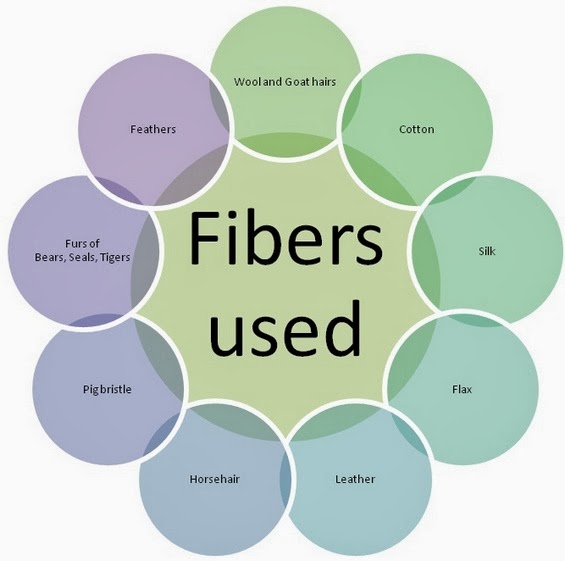
  • The fiber types used were only natural and high performance fibers were not known at that time. The following figure throws light on the fibers used for the military uniforms.
    (FIG.4)
TWENTIETH CENTURY
  • Today’s military equipments are very advanced in all kinds. Sophisticated visual detection systems are used; hence it is very necessary hide troops and equipments by blending in with background.
  • 1902 – Khaki uniforms came into existence. (Khaki means Dung in Persian and Dust in Urdu). The weave used was mainly wool worsted serge, i.e. a twill fabric.
  • Natural environment has always been a threat to the military forces. A number of examples can be given for the defeat of a nation due to the natural environment.
  • 1930s - UK war office[2] introduced combat clothing system which was cautious about providing the following three things
  • Protection
  • Comfort and
  • Practicality
  • 1939 – Worsted Serge battle dress was introduced under the specification E/1037 by Garment Development Section, Royal Dockyard, Woolwich, London [2].
  • 1940 – Armored fighting vehicle crews were provided with one piece coverall black cotton denim.
  • 1941 – Denison smock was introduced in this year. This is a lightweight windproof cotton gabardine fabric with rudimentary camouflage patterning for airborne paratroopers.
  • 1943 – Layered combat clothing system came into existence which led woolen serge into obsoleteness [3].
  • 1944 – Sand colored version of the one piece coverall was used for use in desert.
  • 1945 – Nylon parachute canopies came into usage, Ventile cotton fabric were provided to the air crew. The special features of the Ventile cotton fabric was that they were water proof, water vapor permeable fabric and low twist Sea Island cotton and this was tightly woven.
  • 1970s – Para – Aramid was introduced.
  • Kevlar and Twaron continuous filaments which are woven into tight structure and assembled in multi – layers.
  • This had high tenacity, good energy absorption, and high thermal stability.
  • These garments can receive and neutralize a range of projectiles from low caliber hand guns (5.6 – 11.2 mm) to military bullets (5.56 – 7.72 mm)
  • For protection against military bullets, the fabric will require ceramic tile reinforcements or other hard materials to blunt the tip of metal splinter pointed bullets.
  • 1970 – 100% cotton satin drill fabric in olive green color was introduced.
  • 1972 – DPM (Disruptively Patterned Material) with four color temperate woodland camouflage was introduced and this was the first ever printed material, which was introduced by UK war office.
  • 1990 – Ultra High Molecular Weight Polyethylene with a commercial name Dyneema was introduced. This reduced the weight of the garment by about 15%. These are now used to produce cut resistant gloves, helmets and other protective garments.
All these developments were made keeping in mind that there is balance between garment weight, comfort and protection properties. This was possible because of the introduction of stronger and lighter fiber based reinforcements.

According to the technical textiles as for as ballistic protection is considered, we can see that it will be heavy, bulky and relatively inflexible. Nylon and polyester is used which possess no flame retardancy.

When we see the textile used for ballistic protection, it is also seen that apart from stopping bullets and bomb fragments, they provide high thermal insulation causing heat stress also. And when we go for air permeable fabrics, they are insect proof. Hence providing all the properties in a textile material is very difficult and needs a lot of research.

The properties said above are explained briefly in the following pages.

ENVIRONMENTAL PROTECTION
The military forces have to work in all parts of the globe, in a wide range of environmental conditions, like rain, snow, fog, wind, lightning, sunlight, dust, heat, cold, wet, high UV areas, and wind-chill. Defence standard 00-35 [5] defines the worldwide conditions in which men, women, equipments and weapon have to operate effectively. The highest priority in any environment is the protection of the individual.

THERMAL INSULATION
Defence personnel those who are working in cold/dry conditions like Arctic and Antarctic, and other mountainous regions of the world have to carry clothing, sleeping bags, personal equipments and these material require high levels of thermal insulation. Fibrous material offer resistance to heat transmission due to the air enclosed between and on the fiber surface. Normally an efficient insulator will have 10 – 20% of fiber and 80 – 90% air enclosed in between the surface. The fiber in fabric or other material whatever it is acts a large surface area medium to trap still air .
Thermal insulation
WATER VAPOR PERMEABILITY / WATER PROOFING
Water proof material allows free passage of water vapor. In extreme war operations, one can’t choose the climatic conditions or the intensity of their activities and if the above properties are not apt in the fabric, they may lead to injury or death due to hypo/hyperthermia. The following table will show us the effects of wearing impermeable clothing in different conditions.
Conditions
Activity
Consequences
Cold/ wet climate
Medium activity
Discomfort
Cold/ wet climate in sweat wetted clothing
High activity followed by low activity
Hypothermia
Hot moist climate and wearing protective clothing
High activity
Hyperthermia

CAMOUFLAGE CONCEALMENT AND DECEPTION
The word ‘camouflage’ is derived from French word ‘Camoufler’ meaning ‘to disguise’. The camouflage patterns were introduced by French for the first time during the World War I. but before that plain camouflages were introduced by India in 1850s, i.e. in the form Khaki uniforms. These camouflages should be effective in all the wavebands of detection used by the military forces, i.e. UV, near IR and far IR. The basic objective of the camouflage is that, the observation and detection should be as far as possible, and it should be a passive process.

Textile camouflages are in the form of flexible nets, garnishing, and clothing items.

FLAME REATRDENT HEAT PROTECTIVE TEXTILES
The civilian fires are mainly accidental but as far as the military fires are considered, they are deliberately planned events and out of all the textiles used in military are the first to ignite. Some of the flame retardant applications of textiles in defence are as follows,

One should understand the threats actually brought onto the defence people due to the flame and heat caused in the environment. The following figure depicts the military flame and heat threat.

BALLISTIC PROTECTIVE MATERIALS
The purpose of the ballistic protective materials is not to just stop the speeding bullets but to protect the individual from fragmenting devices as well, i.e. form grenades, mortars, artillery shells, and improvised explosive devices. We should note that the injury caused to the civilians is mainly due to two factors,
  • High velocity bullets from rifles, machine guns which are mainly shot from a long range.
  • Low velocity bullets from hand guns which are shot from close range.
But when it comes to military personnel, they are three main factors.

The technical people who are working on the protective textiles should understand that the velocities of the bullets possess more weightage than the kinetic energy, bullet shape and the composition of the bullet [7].

Another point in this is that, the understanding of the raised levels of protection by the use of the armor and helmet today from the day when there was no armor at all.

This experimentation is done on troops standing in open ground threatened by a mortar bomb.

FIBERS USED IN BALLISTIC PROTECTION
Earlier, woven silk fabrics were used for ballistic protection. More recently high modulus aliphatic nylon 6.6 with high degree of crystalline and low elongation was developed and widely used in body armor and as textile reinforcement in composite helmets.

KEVLAR
Developed by DuPont, this is widely used in the modern generation of light weight body armors. It consists of long molecular chains produced from poly-phenylene terephthalamide. The chains are highly oriented with strong inter chain bonding that results in unique combination of properties, which include high tensile strength at low weight, low elongation at break, high modulus, low electrical conductivity, high chemical resistance, low thermal shrinkage, high toughness, excellent dimensional stability, high cut resistance and flame resistance. It does not melt and is unaffected by moisture. It is five times stronger than steel on an equal weight basis.

TWARON
This is another pararamid fiber. The yarn uses 1000 or more finely spun a single filament that acts as an energy sponge, absorbing a bullet’s impact and quickly dissipating its energy through engaged and adjacent fibers. Because more filaments are used, the impact is dispersed more quickly.

SPECTRA
This fiber is an ultra high strength polyethylene fiber. Ultrahigh molecular weight polyethylene is dissolved in a solvent and fibers are produced through gel spinning process. These fibers are 10 times stronger than steel, more durable than polyester and has a specific strength 40% greater than aramid fibers.

DSM DYNEEMA
It has extremely high strength to weight ratio and is light enough to float on water. It has high energy absorption characteristics and dissipates shock waves faster.

BIOLOGICAL AND CHEMICAL PROTECTION
We should understand that toxic agents cause emotional and lethally horrific effect. These are insidious mass destruction weapons. There are primary and essential devices for protection. There is ori-nasal and full face respirators and these filters out and de-activate toxic species. These respirators contain activated carbon on a textile substrate, which absorbs the agent vapor. The activated carbon are provided in any of the following three forms,
  • Finely divided powder coating
  • Small beads
  • Fiber fabric form.
The activated carbon possesses pore structure which provides a high surface area facilitating absorption of a wide spectrum of toxic gases. There are two methods of removal of toxic gases [8].

Today, the activated charcoal is on air permeable non woven supported on a foam backed textile or a laminate consisting of two textile fabrics sandwiching a charcoal layer.

FUNCTION SPECIFIC STUDY

FLAME RESISTANCE GARMENTS
Protection for the individuals has always been quite important in any workplace. Today, flame resistant suits have become quite indispensable in several kinds of workplace environments. One of the important safety measures is to protect the individuals with good quality flame resistant suits. Flame resistant suits are full-sleeved coveralls, though you can even find the same kind of fire protection with bib overalls. The coveralls are considered to be better because they cover more of the body and hence provide better safety from accidental flames. These suits are generally made with Ultra Soft material which is a blend of 88% natural fiber cotton with 12% of synthetic nylon material.

This blend is considered to be a safety standard in flame resistance. It can keep away high resistance flames, and is also used in the military for the same kind of protection. An advantage is that this material looks quite trendy from the outside, since it uses cotton. So, flame resistant suits can be considered a blend of safety and stud fashion.

Inside the Ultra Soft outer layer, inside, a lining of Modacrylic is provided, which is another high degree flame resistant material. The two linings are kept together with Nomex, which also has fire retarding properties. Most of these flame resistant suits are fastened with brass zippers attached to the front of the suits with Nomex material. The various pockets might also have zippers of brass. So, you can see, each and every component of the flame resistant suits is quite ready to combat any accidental breakthrough of fire.

IMPACT PROTECTION TEXTILES
For years the manufacturers of high-performance apparel have struggled to develop the systems that protect against high energy impacts without sacrificing flexibility, breathability or ease of use. APS is an intelligent fabric that consists of 3-D spacer textile treated with specially formulated, response silicon coating. It remains soft and flexible under normal conditions but when stressed under high impact force; the material instantly becomes rigid and then immediately returns to a flexible state.

This innovative material offers the unique combination of benefits that is particularly suited for use in high performance protective apparel and equipment. These benefits include:
  • Fully integrated active safety that can be stitched directly into the garments
  • Material customization and versatility that allow many creative design possibilities
  • Breathable, flexible and lightweight construction for outstanding comfort and freedom of movement
  • Washable for easy care and maintenance
DECONTAMINATION TECHNOLOGY
In one of the existing technology it is based on micro-porous membranes. The new micro porous membranes have been developed at the U.S. Army Natick Soldier Center using the process of electro-spinning. Scientists at the Naval Research Laboratory’s Center for Bio/Molecular Science and Engineering (CBMSE) have developed a new cost-effective, self-decontaminating ultra thin materials coating that actively destroys pesticides and related chemical agents on contact. The coating neutralizes toxins instantly leaving no hazardous residue, which makes it ideal for use in protective clothing for military personnel and civilians. The coating can also be applied to materials used in filters for water purification, and in wipes for chemical spill clean-ups. Unlike composite fabrics, where rubber or synthetic alternatives are sandwiched between layers, the NRL approach coats each individual thread before it’s woven so that the fabric is treated throughout. This is significant in several ways. It will mean light, comfortable protective clothing that will draw off body moisture when used in warmer climates. And, because the coating is active throughout, it provides better protection against permeation and ensures the integrity of seamed areas on pieced fabric.

In another development the U.S. Army Edgewood Chemical Biological Center (ECBC) developed a patented technology to neutralize organo-phosphorus chemical agents and pesticides. This enzyme-based technology simplifies and improves the process of decontaminating a class of highly toxic chemicals, including nerve agents. Other decontamination methods use corrosive chemicals that are more costly, less efficient, and generate a substantial amount of residue waste.

ECBC partnered with Genencor International, Inc. to manufacture this licensed enzymatic decontamination technology, which is trademarked and known as DEFENZ™. DEFENZ™ is now on the market and available to companies that produce and sell fire fighting foams and sprays. All-Clear™, developed by Kidde Fire Fighting Inc, is the first commercially available decontaminant that incorporates these enzymes developed by ECBC. All-Clear™ neutralizes agents without harmful effects on sensitive apparatuses like landing gear and brake assemblies, and has proved to be non-corrosive in Boeing Series Corrosion testing.

MODULAR COMBAT CLOTHING SYSTEM
The main objectives of the modular combat clothing system are
1. To increase on field performance of the soldier
  • Less weight and improved pack ability
  • Environmentally versatile over a wide range of climatic conditions
  • Increased protection and wear comfort
2. To optimize cost effectiveness
  • Reduction in the number of different articles and materials of clothing
  • Outstanding functionality and longer life cycle
  • Easier adaptation to new developments
CONCLUSION
The main military nations have research programs geared towards future combat and protective clothing as integrated systems. The programs tend to be led by military threats or capability gaps doctrine, rather than exploitation of new technologies for the sake of it. The systems approach involves all the major stakeholders, including, strategic planners, users, equipment capability managers, operational analyzers, R&D scientists, producers, contracts staff etc. The general aims of future systems are:
  • Improve protection against natural and battlefield threats
  • Maintain thermo-physiological comfort or survival in extreme conditions
  • Improve compatibility between and within different clothing components
  • Reduce weight and bulk of materials
  • Integrate functionality so that fewer layers provide multi layer protection
  • Reduce life cycle costs by making systems more effective, durable, and recyclable and by buying few components in the system
REFERENCES
  1. George Washington, Speech to American Congress, 1790 
  2. MG Burns, British combat dress since 1945, Arms and Armor press, Clasell, London, pp 6, 7, 15.
  3. M.Chapell, The British soldier in the twentieth century, Part 5 Battledress 1939-1960, Wessex Military Publishing, Hathersleigh Devon 1987 pp 8 – 16 
  4. GT Holmes, 8th Commonwealth Conference on clothing and General Stores, Department National Defence, Canada 1965 
  5. Defence standard 00-35, Issue 2 Environmental hand book for defence materials Chapter 1-01, Table 2 MOD, Directorate of Standards 6, March 1996, P 5 
  6. C Cooper, Textile as protection against Extreme winter weather’ textiles 1979, 8 (3) 72-83 
  7. L Tobin Military and Civilian Protective clothing, MOD, DCTA lecture given to RMCS wound ballistic course. Jan 1994 
  8. Specification UK/SC/3346G, cloth, Bonded, Multi Fiber Anti Gas, MOD, DCTA, QPS, DIDCOT, OXON, Sep 1982 
  9. Hand Book of Technical Textiles by Sabit Adanur
  10. www.wikipedia.com
  11. www.technicaltextile.net

Mechanics of Fibrous Structure

Saturday, 25 January 2014

Mechanics of Fibrous Structure of Boxing Gloves

Sikander Anwer
Department in Textile Engineering
University of Management & Technology, Lahore, Pakistan
Cell: 0322-4875571 
Email:111811016@umt.edu.pk


Introduction:
I am supposed to design a boxing gloves, which are perfectly used by boxers for their purpose. A boxing gloves is a protective layer between punch and face, which stimulates the impact of a punch in it for damaging the face badly.
Design of boxing gloves
The boxing gloves which I used to made has following properties:
  • Compress-able
  • Comfortable
  • Fit-able
  • Anti-perspiration
  • Anti-bacterial
  • Bearable
  • Good grip
The composition of boxing gloves has several steps in which different stacking are used;

The first layer is the inner most layer which has to be in-contact with the skin. This layer should be absorbent, anti-bacterial, and tensionless. The layer would be of bamboo fiber which has an essential characteristic of environmental friendly.

The second layer should be bearable and water-repellent. It should be of cow hide leather which absorbs the stress and minimized the reaction of the impact.

The third layer should be more compactable, structural, water-repellent and compress-able. The layer should be of synthetic leather that cannot be damaged early and has to tolerate all the forces which boxer applies on it.

The last touch is of aesthetic performance it has good finishes, stretchable, long life, light weight and maintain the structure.

The limitations of the fabric are:
  • Max stress = 4.8263Mpa
  • Max speed= 16m/s
  • Weight= 110Kg
  • Momentum= 1760N/s
  • Compressive Strength= 48.26N
  • Young’s Modulus= 241.3 
a) Momentum= mass x velocity
= 110 x 16 
= 1760N/s

b) Strain= (lo – l) / lo
= (0.16 – 0.2) / 0.2 
= -0.2 (negative signs shows the Compression effect in Gloves)

c) Young’s Modulus= Stress/Strain
= 48.26/0.2 
= 241.3 

Protective Clothing for Space Shuttle

Wednesday, 22 January 2014

1. Introduction:
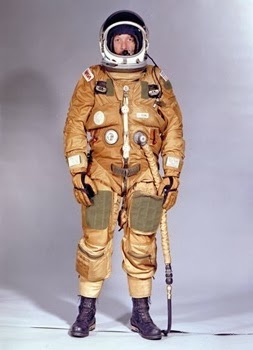
For the outer space shuttle traveler NASA (National aeronautic space authority) has prescribed clothing of special property to protect the space travelers for the harmful environment in the outer space. Two ply fabrics is used for the clothing. The chemically treated cotton fabric plies are 244 grams per square yard satin, 153 grams per square yard weft sateen and 187 grams per square yard mercerized knitted single jersey fabrics. These fabrics are flame retardant finished with THPOS/NH3 and DAP/Urea in two steps. As a result, these type of clothing shows better flame retardancy and burning retardancy property, which is approved by NASA.Such type of fabric are categorized in technical textile.
Space shuttle cloth
At the time of lunching space shuttle, to dissipate surface temperature of space shuttle, water filled bag made of rip-stop nylon fabric is used on its surface. For the outer space shuttle traveler, a special type of clothing has been made.

While early space suits were made entirely of soft fabrics, today’s Extravehicular Mobility Unit (EMU) has a combination of soft and hard components to provide support, mobility and comfort. The suit itself has 13 layers of material, including an inner cooling garment (two layers), pressure garment (two layers), thermal micro meteoroid garment (eight layers) and outer cover (one layer).

2. The materials used in space shuttle cloth include:
  • Nylon tricot
  • Spandex
  • Urethane-coated Nylon
  • Dacron
  • Neoprene-coated Nylon
  • Mylar
  • Gortex
  • Kevlar (material in bullet-proof vests)
  • Nomex
3. There are four theoretical approaches to suit design:

3.1 Soft suits
Soft suits typically are made mostly of fabrics. All soft suits have some hard parts; some even have hard joint bearings. Intra-vehicular activity and early EVA suits were soft suits.
 
3.2 Hard-shell suits
Hard-shell suits are usually made of metal or composite materials and do not use fabric for joints.
 
3.3 Hybrid suits
Hybrid suits have hard-shell parts and fabric parts.
 
3.4 Skin tight suits
Skintight suits, also known as mechanical counter pressure suits or space activity suits are a proposed design which would use a heavy elastic body stocking to compress the body.

4. Advantages of Space shuttle cloth:
  • The space suit provides air pressure to keep the fluids in body.
  • Most space suits provide a pure oxygen atmosphere for breathing.
  • Space suits use lithium hydroxide canisters to remove carbon dioxide.
  • To cope with the extremes of temperature, most space suits are heavily insulated with layers of fabric and covered with reflective outer layers (Mylar or white fabric) to reflect sunlight.
  • To protect the astronauts from collisions with micro meteoroids, space suits have multiple layers of durable fabrics such as Dacron or Kevlar.
  • Modern space suit helmet coverings have mounted lights so that the astronauts can see into the shadows.
  • To help this problem, space suits are equipped with special joints or tapers in the fabric to help the astronauts bend their hands, arms, legs, knees and ankles.
5. Disadvantages of Space shuttle cloth:
  • In weightlessness, it is difficult to move around.
  • Space suits offer only limited protection from radiation.
6. Uses:
Astronauts wear space suit during launch and landing of the space shuttle. Astronauts used for spacewalks.

Reference:
  1. http://www.nasa.gov/audience/forstudents/5-8/features/what-is-a-spacesuit-58.html#.UtI4RM6_7IU
  2. http://en.wikipedia.org/wiki/Space_suit
  3. http://Space%20suit%20-%20Wikipedia,%20the%20free%20encyclopedia.htm
  4. http://depts.washington.edu/matseed/mse_resources/Webpage/Space%20Shuttle%20Tiles/Space%20Shuttle%20Tiles.htm
  5. http://en.wikipedia.org/wiki/Space_Shuttle_thermal_protection_system
  6. Garments Merchandising by Professor M.A.Kashem 
 

What is Composite | Textile Structural Reinforced Composites

Sunday, 19 January 2014

An Assignment on Composite Material
Abinaya
Senior Executive, MNC, India
Email: aglaia.abi@gmail.com


Composites
The term composites originally arose when two or more materials where combined or bonded together to form a heterogeneous mixture in order to rectify some shortcoming of a particularly useful component. Different research workers have given different definition of composites. Among this the definition given by George Lubin (1969) is that a composite material is created by the synthetic assembly of two or more components (selected filler or reinforcing agent and compatible matrix binder) in order to obtain specific characteristics and properties.
Textile composite
Composite materials have a bulk phase, which is continuous, called the matrix, and one or more dispersed, non-continuous phases, called the reinforcement, which usually has superior mechanical orthermal properties to the matrix. The region between the two can be simply a surface, called an interface, or a third phase, called an interphase.

1.1 Classification of Composites
Classification of Composites
Composites can be classified on the basis of their structural components and the matrix, according George Lubin (1989) the composites can be classified based on the structural components used as,
  • Fibrous (composed of fibres in a matrix) composites
  • Laminar (composed of layers of materials) composites
  • Particulate (composed of layers of materials ) composites
Particulate composites can be further subdivided into,
  • Flake ( flat flakes in a matrix)
  • Skeletal (composed of a continuous skeletal matrix filled by Second material).
Based on the matrix used composites can be classified as thermoplastic Composites and thermosetting composites.

1.1.1 Thermoplastic composites
Compared to thermosetting composites, a thermoplastic composite has the following major advantages.
  • Heating or steaming will not make the composites brittle.
  • Shorter cure cycle and
  • Ability to recycle.
According to Huang Gu et al (2007) thermoplastic composites have the following advantages.
  • High impact strength
  • Tolerance for damage is high
  • Low price and recyclable.
  • Thermoplastic matrix can withstand high temperatures and still possess good flow property.
1.1.2 Thermosetting composites
Composites which are produced using the thermoset matrix are named as thermoset composite. Thermoset matrix additionally requires hardener for making the composites and it also requires the curing. This will automatically increases the production cost and processing time.The degree of wetting during the production
process is important for a good adhesion between reinforcement and matrix.

When applying thermosets the viscosity can be lowered, this helps in better wetting between reinforcement and matrix. One of the biggest disadvantages of thermoset composites are once it is cured it cannot be reformed into another shape.

1.2 TEXTILE STRUCTURAL REINFORCED COMPOSITES
Textile structural composites represent a class of advanced materials, which are reinforced with textile preforms for structural or load bearing applications. Presently, textile structural composites are part of a larger category of composite materials (Shishoo et al 1971 and Wiemer et al 2000). In general,composites can be defined as a selected combination of dissimilar materials with a specific internal structure and external shape. The unique combination of two material components leads to singular mechanical properties and superior performance characteristics not possible with any of the components alone.

Additionally composite materials are often overwhelmingly superior materials (e.g. metals) on strength to weight or stiffness to weight basis(Kaldenhoff and Wuifhorst 1997). Textile structure as a reinforcement and resin as matrix have led the production of textile fabric reinforced composite.

1.3 SELF REINFORCED COMPOSITE (SRC)
SRC refers to a composite comprising polymeric oriented reinforcing elements (usually fibers or tapes) or rigid particles in a matrix of the same polymer. However, there are other kinds of SRC‟s based on molecular orientation. They comprise homogeneous polymers or polymer blends that have a level of preferred molecular orientation (through extrusion, injection molding or a solid-state stretching process), where the “reinforcement” is at a molecular level. This technique has been used to develop PP-based SRCs. The preform can be developed by various techniques such as weaving, knitting, nonwoven and braiding. According to Horrocks (2004) textile preform is classified in the following manner. Figure shows the classifications of textile perform.
Textile perform

Application of Knitted Fabrics in Technical and Medical Textiles

Friday, 27 December 2013

APPLICATION OF KNITTED FABRICS IN TECHNICAL & MEDICAL TEXTILES 
 Abdulwahid Dadhiwale
D.K.T.E society’s textile and enginieering institute of technology
Diploma In Textile Manufactures
Email: wahidw202@gmail.com


Abstract:
Knitted fabrics and knitting technology play very important role on the fields of technical and medical textiles and their importance is ever greater. Experts estimate that their annual consumption is increasing by 3,8 % in average and it can reach about 24 million tons in 2010. Within this the consumption of each sector is increasing. Roughly one third of the world’s fibre consumption is used for production of technical textiles.

The term “technical textiles” covers many fields of application that are mirrored in the terminology of Tech-textile which is very much used generally when grouping these products. Techtextil differentiates 11 groups and knitted fabrics and products made by knitting technologies can be found in each of them.

The lecture introduces such applications on many examples. We think that use of knitting technologies in the development of technical and medical textiles can help this sector to survive this difficult period of the European textile industry.

Keywords: knitting, knitted fabrics, technical textiles, medical textiles

1. INTRODUCTION
Importance of technical textiles is great and increasing. Experts estimate that annual rising ratio of this application of textile materials is 3.8 % in average and consumption in each filed of this group of applications is anticipated as growing. Roughly one third of the quantity of the world’s fibre consumption is used in production of technical textiles. Range of technical textiles is very wide. There are various definitions of this term from which we usually use the list disseminated by the well known international fair of these products, Techtextil, which contains 11 groups.
Fig 1.Technical textiles
Thus, we can say that the term “technical textiles” can be defined as do not belong to them the usual underwear and outerwear products as well as products called ordinary home textiles and household textiles (table linen, bed linen, dishcloth, curtains, etc.) except the ones used in furniture and upholstery.

Most of technical textiles are made of non-conventional materials, they are usually man-made fibres, in many cases special types developed for specific applications. Metallic yarns (thin wires) alone or parallel to other yarns are also used in some technical knitted fabrics. However, traditional materials, including those of natural origin, play important role in some fields.

Though each production technologies are involved in these fields, from spinning to the various kinds of fabric manufacture, including manufacture of ropes and twines, we concentrate in this paper to the role of knitting technologies.

2. USE OF KNITTING TECHNOLOGIES IN MANUFACTURE OF TECHNICAL TEXTILES
Studying the objects exhibited on fairs and the articles published in technical papers and on the Internet we have the experience that various kinds of warp knitted fabrics play the most important role among knitted technical textiles. These fabrics are made on tricot, raschel, crochet and knit braiding1 machines. Products of these machines can be used in themselves, like nets or bandages, but also as reinforcement materials in composites or backing materials for laminated or coated fabrics.

However, besides warp knitting technology important products are made also on weft knitting, mainly on circular knitting machines but V-bed flat knitting must not be neglected either.

2.1 Nets
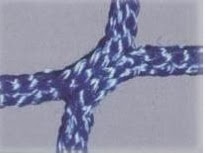
Application field of nets is extremely wide. Agriculture, fishing, packaging, transport, sports, shading technology, construction, healthcare, surgery, safety technology and military presents many good examples for that. Many of these nets are made by raschel or crocheting technology the great advantage of which is that they do not contain knots (Fig. 2). This makes the nets easier to handle because the layers do not tangle up and there are no knots that could harm the good packed into the net. Warp knitted nets – both flat and tubular ones – can be produced with very high productivity.

Materials used for net manufacture are very different, depending on the end use. Spun yarns or filament yarns, narrow plastic tapes are commonly used for this purpose. Elastic nets are made with using of elastane yarns.
Figure 2: Raschel net does not contain knots
Width of flat nets knitted on raschel or tricot machines may reach as well 5 to 6 metres while to make narrower variants (up to 100 to 120 cm width) crochet machines are also available. Raschel machines with two needle bars are able to produce wide tubular net fabrics. To manufacture tubular nets of smaller diameters (from 1 or 2 centimetres to about 20 cm) knit breading machines can be used very effectively but their final diameter can be extended in the practice if they contain elastane yarns.

2.2 Knitted fabrics with orientated behaviours
Knitted fabrics with orientated behaviours are made usually with lots of yarns laid lengthwise, crosswise and/or diagonally into the fabric. Their keeping together is performed by warp knitted loops. Aim of these 1 Knit braider is a circular warp knitting machine working with latch needles, making similar products as braiding machines (nets, twines, etc.)

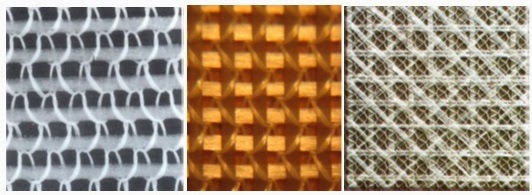
a) b) c)
Figure 3: Knitted fabrics with orientated behaviours
a) Monoaxial [5], b) biaxial, c) multiaxal [5]

structures is mainly to reduce the stretch and/or to increase the forth of the fabric in one or more directions. If this effect is realized only in one direction (lengthwise or crosswise) the fabric is called “unidirectional” or “monoaxial”. If this behaviour asserts itself in both directions the fabric is called “biaxial”. “Multiaxial” or “multidirectional” fabrics have almost the same behaviour in every direction (Fig. 3.). To manufacture such fabrics special tricot and raschel machines have been developed completed by equipment to prepare and lead the lots of reinforcing yarns into the place of loop formation. In these fabric constructions the laid-in yarns play the main role, the loops only link them together.

There are a great number of end uses for these fabrics. Biaxial fabrics with PVC coating, for instance, are used for manufacture of stressed roof constructions by which very wide spaces can be covered. Fabrics with directed behaviours are available also as reinforcement materials of composites or for geogrids.

2.3 Spacer fabrics
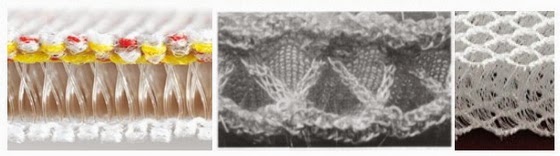
Among knitted fabrics perhaps the most spectacular development can be registered in case of spacer fabrics. This is already the product of the 21st century, their development began only several years ago but it has made great progress since then. Though the principle of the fabrication is not new, it goes back to the manufacture of plush fabrics on raschel machine, the adaptation of this technology to make a completely new type of fabric is very ingenious. At the beginning they were developed really on two needle bar raschel machines but now there are also circular knitting machines on the market for manufacturing of such products and, of course, V-bed flat knitting machines are also able to make spacer fabrics of some kinds (Fig. 4). The two surface layers of spacer fabrics are usually linked by relatively thick monofilaments which makes the fabric elastic when pressed in thickness direction. This is the most important reason why spacer fabrics have found many fields of application. They can substitute foam in seats or beds, in orthopaedic support devices, in bras and shoes. It can serve in smart clothes as heat insulation or for forming of ventilation passages. As a type of geotextiles spacer fabrics can be used to lead off water from the soil. In manufacturing of composites used in the motor industry or ship building they can work as reinforcement inlay. Using proper yarns or with application of special treatment they can be electrically conductive, flame retardant, antibacterial, etc.

As we see at this moment, most spacer fabrics used are made on raschel machines or, in recent times, also on crochet machines. Needle bed distance on these machines can be varied within wide range and fabric thickness can reach even 60 mm. On circular knitting machines needle bed distance is much more limited, only thinner (thickness of some millimetres) spacer fabrics can be made on them. However, these variants are also very important and can be found in many products. I am convinced that spacer fabrics will have high importance in the future among technical end uses,including healthcare. a) b) c)
a) Raschel [5], b) circular knitted [4], c) V-bed flat knitted [3]
Figure 4: Spacer fabrics
2.4 Stitch bonding
Stitch bonding machines combine knitting and sewing. They have grown from warp knitting technology and their products occupy an intermediate position between knitted and nonwoven fabrics. This fabric contains a carded web which is reinforced by yarns or loops formed from fibres pulled out from the web itself. Needles of the warp knitting machine pierce holes through the web and work like a sewing needle when forming a seam of chain stitching (called pillar stitch in warp knitting technology) or zigzag seam where stitches made on neighbouring needles couple with each other (called tricot lap in warp knitting technology). These fabrics have great importance in almost each class of technical textiles. They are used very often as reinforcing materials in composites or for heat or sound insulation, filling materials in clothes or furniture, etc. A further variant of such fabrics is when not only carded web but lots of yarns are laid in various directions over the web and all of these are stitched together. This formation may be called “composite fabric” since it is a composition of various types of textiles (web and yarns). They find application fields among filters, geotextiles, reinforcement materials in composites, etc.

Advantage of these fabrics is that the carded web may be made of various fibres which, because of their length or quality, can not be spun, even in various blending, fabric thickness and stitch density (number of stitches in length unit) as well as yarn counts (in accordance with machine cut) can be varied in relatively wide range. The fabric can be easily formed. At the end of its lifetime it can be torn and recycled.

2.5 Knitted fabrics in construction
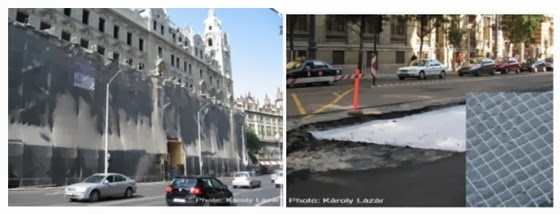
Construction industry is a great market for textiles and also for knitted fabrics among them. Around buildings being under construction or renovation the scaffold is usually covered by raschel-knitted net (Fig. 5) made of polypropylene foil tapes. Knitted fabrics can be used also to reinforce wall coverings, both outside and inside. Some types of geotextiles and geogrids are also knitted structures, as mentioned above (Fig. 6) Many buildings, and not only provisional ones, have roofs made of textile fabrics (sports stadiums, air terminals, halls for various functions, etc.). If this roof is made from knitted fabric bi- or multiaxial knitted structures are used with waterproof and weatherproof coating. Huge areas, many hundreds of square metres can be covered by such fabrics.
Figure 5 and 6: Scaffold covered by raschel net and Knitted composite fabric used for driveway reinforcement

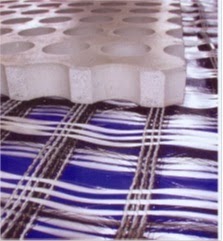
Figure 7: Warp knitted fabric for reinforcment of concrete slab [2]
Another possible application of knitted fabrics in construction is textile reinforced concrete. There are warp knitted structures developed especially for this purpose like the one shown in Fig. 7. Textile reinforced concrete has the advantage that it is much lighter than the one reinforced by steel bars.

2.6 Knitted fabrics in medical treatment
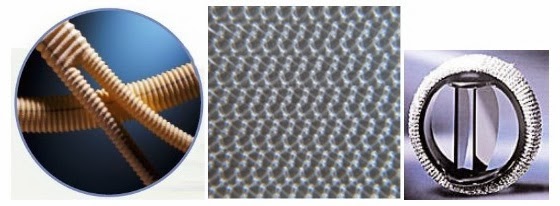
Many kinds of textiles are used in medical treatment. It is not surprising that a great part of clothing worn by doctors and nurses in hospitals and clinics is product of the knitting industry (e.g. undershirts, socks). But sometimes they are not conventional ones, they are made from yarns or with finishing that make them antibacterial against infections or against of rising of unpleasant sweaty smell. Various types of bandages (both rigid and elastic), surgical stockings, certain parts of orthopaedic equipment (ortheses) (like knee-, wrist- and elbow-braces, calf and lumbar supports, etc.) are also made by knitting technology. An important application field for spacer fabrics is manufacturing of mattresses for beds, operating tables and wheelchairs. Knitted products find application field also among implants: artificial blood vessels (they can be circular knitted or warp knitted, the latter is made on double needle bar raschel machine and can be made also in Y form), surgical meshes (made on tricot machine), coverings of artificial heart valves, etc. (Fig. 8). Thus, development and application of textiles open interesting possibilities for medical sciences and vice versa: manufacture of textiles for medical treatments offer important possibilities for the textile industry. Cooperation of doctors and technical experts of the textile industry can lead to development of new surgical technologies. Structure of the textiles used as implants is determined by its material composition, fibres’ behaviour and features of degradation. Materials of sutures and implants having biologically good properties, designable absorption and degradability and that endure the sterilization process are continuously subjects of research. At the same time, continuous development of textile technologies and machines enables to develop newer and newer methods in surgery and medical treatment. For this mutual development textile technologists and doctors must closely cooperate, while all the administrative procedures concerning manufacturing and trading of such products must be strictly respected.

2.7 Knitted fabrics in functional clothes

Knitted fabrics may be important components of functional clothes, too. For example, spacer fabrics can be used here as lining that, due to its hollow structure, enables ventilation inside the garment or, due to its elastic behaviour in thickness direction, protects against pressure or hit. This is why this fabric is a penchant for lining of motorcyclists’ protective garments. The speciality of a spacer fabric that there is a distance between its two surfaces but they can be springily pressed together enables to use them as electric switch if electrically conductive yarns are used in the two isolated surfaces. When they connect to each other under pressure an electric signal can be created. Also pressure sensor can be built in between the surfaces. Cables can be led in the inside hollow. Undershirts, trousers, socks made from elastic knitted fabrics fit close to the body and if sensors are fastened on them they can transport signals of the movements and the state of the body (perspiring, pulse, breath frequency, etc.).

Remarkable developments are going on – also in Hungary – with knitted fabrics containing metallic fibre components for manufacture of protective underwear against electromagnetic radiation as well as with other types of underwear that contain modacrylic or carbon fibres to make the knitted garments flame retardant. Socks made from heat resistant aramide fibres do good service on hot workplaces. On the recent Technical textile in 2009 a knitting factory presented a complete set of knitted underwear (long-sleeve shirt, trousers, socks, a) b) c)
Figure 8: Knitted implants
a) Artifitial blood vessel [6], b) surgical mesh [8], c) artificial heart valve [7]

hood) made of a special blending of modacrylic, aramide and cotton fibres to be worn in hot work environment. An other set of knitted underwear was made of antistatic polyester completed by antibacterial treatment.

3. CONCLUSIONS
All of these examples prove that there are very many possibilities for the European knitting industry to renew. Hungary has established, under the umbrella of the Hungarian Society of Textile Technology and Science, the National Technology Platform for Renewal of the Textile and Clothing Industry (TEXPLAT), joining the Technology Platforms created by the European Union. Aim of the European Union with this initiative was to strengthen the research and development activity and to speed up the realization of results of innovation in order to react successfully to the challenge of global competition. One of these European Platforms is the European Technology Platform for the Future of the Textile and Clothing Industry (ETP-FTC) – this is the background of the Hungarian project.

Within this project the Hungarian Society of Textile Technology and Science prepared in 2009 a Strategic

Plan for the research, development and innovation of the Hungarian textile and clothing industry. In this plan all the possible scopes of development were examined and evaluated. Many proposals have been

formulated also for the knitting industry, most of them are in connection with the subjects expounded above. Our opinion and the proposals have been collected in a study presented to the concerning government office, calling the officials’ attention to the aspect that the Hungarian textile and clothing industry could chose a completely new way for developing and it must not be considered as subject of write-off. The next step is going on this year: we have to discuss with entrepreneurs what can be really put into practise from our proposals. They are in difficult position nowadays, the Hungarian economy is not on the top and only few companies of the textile and clothing industry are able to invest new technology. However, there are also good examples and we do hope that some of the possible solutions will be realized in the near future.

4. REFERENCES
  1. AVR – Allgemeiner Vliesstoff-Report, 2007. No. 3.
  2. Liba – New double needle bar knitting machine for technical textiles. Melliand International, 2008. No. 2. p. 105 
  3. Kanakaraj, P.; Anbumani, N.: 3D knitted spacer fabrics and their application. Melliand International, 2007. No. 1. pp. 47–52.
  4.  http://www.mayercie.de/en/news/43_1687.htm Accessed: 2009-01-27 
  5. Karl Mayer’s leaflets
  6. www.goremedical.com/en/file/73641.pdf Accessed: 2009-04-09 
  7. http://www.ismaap.org/81.0.html Accessed: 2009-04-06 
  8. http://www.tmte.hu/11kiadvanyok/111matete/111_2009_04_pdf/133_Techtextil.pdf Accessed: 2010-02