Halo Sobat ! | Members area : Register | Sign in
About me | SiteMap | Arsip | Terms of Use | Dcma Disclaimer

Footer

Powered by Blogger.

Social Icons

Featured Posts

Slider(Do not Edit Here!)

Minha lista de blogs

Publicidade 2

Cantinho do Blog

Parcerias

Hospedagens FREE

Dominios FREE

Publicidade 1

widget

Pojok Blog

Arsip

Sample text

Sample Text

Sample Text

Powered By Blogger
Powered By Blogger
Powered By Blogger

Perangkat SD

Perangkat SMP

Berita Pendidikan

Pengumuman

..::Aprendiz MUOnline::..

..::Ultimate Vendas::..

..::Central MU Online::..

..::Criando Portais::..

..::Viciados MU::..

..::Universe Divulgação::..

Visitor Counter

Google Search

..::Mixer Divulgação::..

You can replace this text by going to "Layout" and then "Page Elements" section. Edit " About "

..::Rádios Online::..

Recent Comments

..::Melhor Divulgação::..

..::Vermelho Divulgação::..

..::Extreme Divulgação::..

..::Control Downs::..

..::Divulgaçao::..

..::FreeXat parceiro top::..

..::Ciados MU Online::..

..::Nosso Banner no seu Site::..

About Me-

Seguidores

Seguidores

Social Icons

Musik

Translate

..::Majestic Hacker::..

..::Exclusivo MU Online::..

Translate to your language

Fox Life

Pages

Pages

Publicidade

Parceiros

Social Icons

Product Life Cycle | Stages and Limitations of Product Life Cycle (PLC)

Monday, 2 December 2013

Product Life Cycle

Product life cycle is a business analysis that attempts to identify a set of common stages in the life of commercial products. In other words the ‘Product Life cycle’ PLC is used to map the lifespan of the product such as the stages through which a product goes during its life span.
Graph of Product Life Cycle
Product life cycle is the course of a product’s sales and profits over time.

Product life cycle (PLC) deals with the life of a product in the market with respect to business or commercial costs and sales measures.

The five stages of each product lifecycle are product development, introduction, growth, maturity and decline.

A company’s positioning and differentiation strategy must change as the product, market, and competitors change over the product life cycle(PLC)

When we say that a product has a life cycle we assert four things:
  1. Products have a limited life.
  2. Products sales pass through distinct stages, each posing different challenges, opportunities and problems to the seller.
  3. Profits rise and fall at different stages of the product life cycle.
  4. Products require different marketing, financial, manufacturing, purchasing, and human resource strategies in each life – cycle stages.
Product Life-Cycle Strategies
The Product Life Cycle (PLC) has Five Stages
  1. Product Development, 
  2. Introduction, 
  3. Growth, 
  4. Maturity, 
  5. Decline
Not all products follow this cycle: The product life cycle concept can be applied to a:
  • Product class (soft drinks)
  • Product form (diet colas)
  • Brand (Diet Dr. Pepper)
Using the PLC to forecast brand performance or to develop marketing strategies is problematic

Product development
  • Begins when the company develops a new-product idea
  • Sales are zero
  • Investment costs are high
  • Profits are negative
Introduction
  • Low sales
  • High cost per customer acquired
  • Negative profits
  • Innovators are targeted
  • Little competition
Grouth
  • Rapidly rising sales
  • Average cost per customer
  • Rising profits
  • Early adopters are targeted
  • Growing competition 
Marketing strategies for Growth stage
During the growth stage, the firm uses several strategies to sustain rapid market growth.
  • Improves product quality and adds new features and improved styling.
  • Adds new models and flanker products(i.e., products of different sizes, flavors, and so forth that protect the main product).
  • It enters new market segments
  • It increases its distribution coverage and enters new distribution channels.
  • It shifts from product- awareness advertising to product- preference advertising.
  • It lowers price to attract the next layer of price – sensitive buyers. 
Maturity
  • Sales peak
  • Low cost per customer
  • High profits
  • Middle majority are targeted
  • Competition begins to decline 
Marketing strategies for Maturity stage
Three potentially useful ways to change the course for a brand are market, product, and marketing program modification.

Market Modification
  1. Sales volume = no. of brand users * usage rate per user.
  2. Expand the no. of brand users
  3. Convert nonusers
  4. Enter new market segments
  5. Attract competitors’ customers
  6. Increase the usage rate among users
  7. Have consumers use the product on more occasions.
  8. Have consumers use more of the product on each occasion
  9. Have consumers use the product in new ways.
Product modification
Trying to stimulate sales by modifying the product’s characteristics through

Quality improvement:
Aims at increasing the product’s functional performance.

Eg: Aashirvaad, Annapoorna, Pillsbury, Naturefresh

Feature improvement
Aims at adding new features, such as size, weight, materials, additives, and accessories, that expand the product’s performance, versatility, safety, or convenience.

Style improvement
Aims at increasing the product’s esthetics appeal.

Eg; New car models, New Coke 
 
Decline:
  • Increase investment
  • Resolve uncertainties - stable investment
  • Selective niches
  • Harvesting
  • Divesting
  • To establish a system for identifying weak products.
  • Some firms’ abandon declining markets earlier than others.
Limitations of Product Life Cycle (PLC)
Product life cycle is criticized that it has no empirical support and it is not fruitful in special cases. Different products have different properties so their life cycle also vary. It shows that product life cycle is not best tool to predict the sales. Sometimes managerial decisions affect the life of products in this case Product Life Cycle is not playing any role. product life cycle is very fruitful for larger firms and corporations but it is not hundred percent accurate tool to predict the life cycle and sales of products in all the situations.
 

Concept of New Product Development

Sunday, 1 December 2013

PRODUCT DEVELOPMENT CONCEPT
The product idea concept is first developed from market and consumer research but with consideration of the technical aspects of the product. Usually, it is a combination of internal company information searching combined with consumer or, in industrial marketing, customer discussion groups. In industrial product development, it has been shown that selecting the most innovative customers for product concept development reduces the time and improves the product concepts. The product idea concept research leads to a more detailed description of the product ideas and also includes screening of the ideas.

Product Development is the design and engineering required to make products serviceable, salable, producible and profitable.

The basic concept involved in PD may be of two types:
  1. Creative
  2. Technical
  • Creative design focuses on analysis and creativity.
  • Technical design which involves perfecting the style, fit and patterns and developing detailed specifications and costs.
  • The product can either be one that is new in market or one that is new to your particular company or existing product that has been improved.
Why develop New Product?
  • To create stars and cash cows for the future
  • To replace declining product
  • To take advantage of new technology
  • To defeat rivals
  • To maintain/increase market share
  • To keep up with rivals
  • To maintain competitive advantage
  • To fill gap in the market
PRODUCT DEVELOPMENT CONCERNS?
Management, Designers, Merchandisers are involved in the development of a line or collection of the fashion manufacturer’s product.

PRODUCT DEVELOPMENT PROCESS:
Apparel product development involves three phases:
  • Pre-adoption
  • Line-adoption
  • Post-adoption
Pre-adoption

1. This phase involves:
  • Design Features
2. Design development through sketching, draping and CAD.

3. CAD system allows trial and error in developing concepts for approval without having to sew physical samples.

4. Design process may be conducted simultaneously in different sequences to reduce time for the product development.

5. Design may be original ,draw on fabric, stored in computer or given by the consumer.
  • Piece Goods
6. Fabric selection. Material testing for performance.

7. In the pre-adoption phase it is make sure that the fabric or other materials that we are going to use would be available in large quantity for production.
  • Trims
8. Accessories selection and testing if required.

9. The accessories and trims that are going to be used in the garment must be available.

Line-adoption
1. This phase involves:
  • Integration of line development and line presentation
2. Planning a Collection
3. Developing a Collection (Design Development)
  • Developing a sample garment
  • Preparation of sales samples
Post-adoption
Which designs will become styles in the line and how the styles relate to the line planning?
This phase involves:
  • Perfect Styling and Fit.
Because sometimes the fitness present in the sample cannot be achieved in the production process.
  • Engineering production patterns.
  • Assembly methods (to check the suitability in production.
  • Developing Styles.
  • Quality specifications.
  • Estimate detailed costs.
  • Estimate the operation cost. 
 

Stages of the New Product Development (NPD) Process

Tuesday, 26 November 2013

New-Product Development Process:
New product development is a process which is designed to develop, test and consider the viability of products which are new to the market in order to ensure the Growth or survival of the organization.

Every entrepreneur knows that productivity is one of the key ingredients for successful product development. New product development (NPD) is the complete process of bringing a new product to market. A product is a set of benefits offered for exchange and can be tangible (that is, something physical you can touch) or intangible (like a service, experience, or belief).

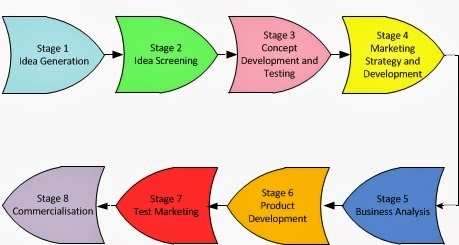
Stages of New Product Development:
New product development as the first stage in generating and commercializing new product within the overall strategic process of product life cycle management used to maintain or grow their market share.
  1. Idea Generation
  2. Idea Screening
  3. Concept Development and Testing
  4. Business Analysis
  5. Market Testing
  6. Technical Implementation
  7. Commercialization
  8. New Product Pricing
    Stages of the New Product Development Process
A short description of these stages are point out below……..
1. Idea Generation
  • Idea Generation is often called the “NPD” of the NPD process. Idea generation is continuous, systematic search for new product opportunities. It involves delineating sources of new ideas and methods for generating them.
  • Ideas for new products can be obtained from basic research using a SWOT analysis (Strengths, Weaknesses, Opportunities & Threats). Market and consumer trends, company’s R&D department, competitors, focus groups, employees, salespeople, corporate spies, trade shows, or ethnographic discovery methods (searching for user patterns and habits) may also be used to get an insight into new product lines or product features.
  • Lots of ideas are generated about the new product. Out of these ideas many are implemented. The ideas are generated in many forms. Many reasons are responsible for generation of an idea.
  • Idea Generation or Brainstorming of new product, service, or store concepts - idea generation techniques can begin when you have done your OPPORTUNITY ANALYSIS to support your ideas in the Idea Screening Phase (shown in the next development step).
2. Idea Screening
The object is to eliminate unsound concepts prior to devoting resources to them.
  • The screeners should ask several questions:
  • Will the customer in the target market benefit from the product?
  • What is the size and growth forecasts of the market segment / target market?
  • What is the current or expected competitive pressure for the product idea?
  • What are the industry sales and market trends the product idea is based on?
  • Is it technically feasible to manufacture the product?
  • Will the product be profitable when manufactured and delivered to the customer at the target price?
3. Concept Development and Testing
Concept testing present the consumer with a proposed product and measure attitudes and intention at this early stage of development.
  • Develop the marketing and engineering details
  • Investigate intellectual property issues and search patent databases
  • Who is the target market and who is the decision maker in the purchasing process?
  • What product features must the product incorporate?
  • What benefits will the product provide?
  • How will consumers react to the product?
  • How will the product be produced most cost effectively?
  • Prove feasibility through virtual computer aided rendering and rapid prototyping
  • What will it cost to produce it?
  • Testing the Concept by asking a number of prospective customers what they think of the idea - usually via Choice Modelling.
4. Business Analysis
Includes development of three part strategy plan
  • Describe the market’s size, structure, and behaviour, the planned product positioning, and the sales, market share, and profit goals for first few years.
  • Outlines the planned price, distribution strategy, and marketing budget for the first year.
  • Describes thelong-run sales and profit goals and marketing-mix strategy over time.
5. Beta Testing and Market Testing
  • Test marketing involves placing a product for sale in one or more selected areas and observing its actual performance under the proposed marketing plan
  • Produce a physical prototype or mock-up
  • Test the product (and its packaging) in typical usage situations
  • Conduct focus group customer interviews or introduce at trade show
  • Make adjustments where necessary
  • Produce an initial run of the product and sell it in a test market area to determine customer acceptance
6. Technical Implementation
  • New program initiation
  • Finalize Quality management system
  • Resource estimation
  • Requirement publication
  • Publish technical communications such as data sheets
  • Engineering operations planning
  • Department scheduling
  • Supplier collaboration
  • Logistics plan
  • Resource plan publication
  • Program review and monitoring
  • Contingencies - what-if planning
7. Commercialization
  • Launch the product
  • Produce and place advertisements and other promotions
  • Fill the distribution pipeline with product
  • Critical path analysis is most useful at this stage
8. New Product Pricing
  • Impact of new product on the entire product portfolio
  • Value Analysis (internal & external)
  • Competition and alternative competitive technologies
  • Differing value segments (price, value and need)
  • Product Costs (fixed & variable)
  • Forecast of unit volumes, revenue, and profit